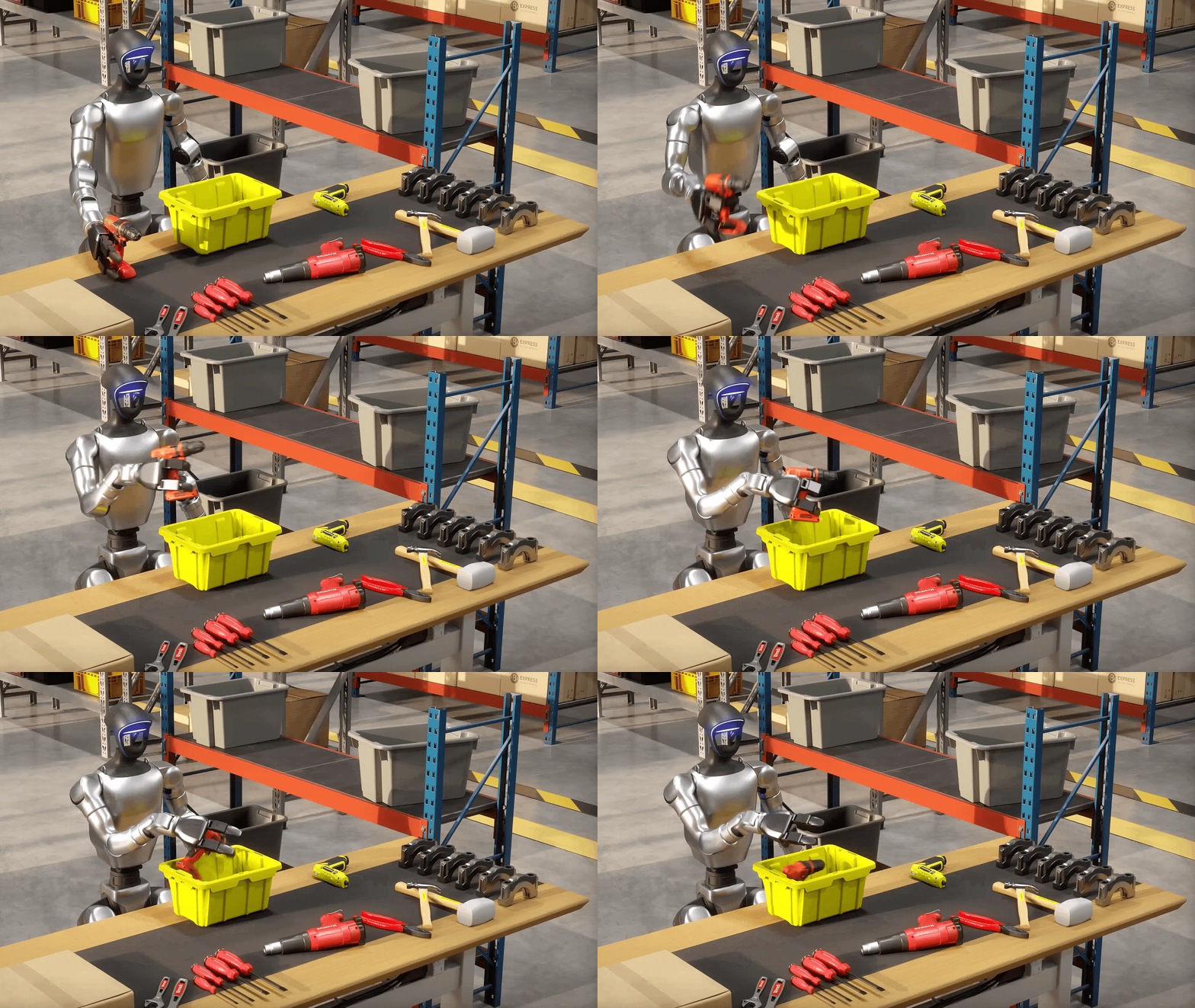
At a mine in Australia, a truck the size of a small building can work through the night without a driver in the cab. Komatsu has now commissioned 1,000 autonomous ultra-class haul trucks, which have collectively moved more than 11.5 billion tonnes of material.
In American cities, Waymo’s cars carry paying passengers without anyone behind the wheel.
Inside Amazon, more than one million robots move inventory through a fulfilment network coordinated by software.
Intuitive Surgical’s da Vinci systems helped perform more than three million procedures last year. Zipline’s aircraft have completed millions of autonomous deliveries.
Ok, but all of this has been happening for almost a decade.
So why is there a new wave of interest and investments into general-purpose humanoids which are doing basic stuff like tidying up your bedroom in slow-motion?a
Figure’s Helix 02 shown above recently walked around a kitchen, unloaded dishes, stacked them on a counter, reloaded the machine and started the cycle. The sequence took four minutes and involved 61 locomotion and manipulation actions. It was slower than a person and produced none of the industrial throughput of a mine or warehouse. It was also working inside a room that had made almost no concessions to the robot.
That discrepancy has little to do with the physical stakes. Mining, surgery and urban driving are dangerous, expensive and unforgiving. They also come with mapped roads, operating procedures, redundant sensors, remote supervision and years of engineering designed to reduce uncertainty.
A kitchen offers plates at different angles, drawers that resist, objects hidden behind the robot’s own hands and small errors that alter every action that follows. It was designed for people rather than automation.
Commercial robotics expanded by building reliable machines for well-understood worlds.
The current boom is driven by a harder proposition: intelligence that can move between worlds without requiring each one to be rebuilt first.
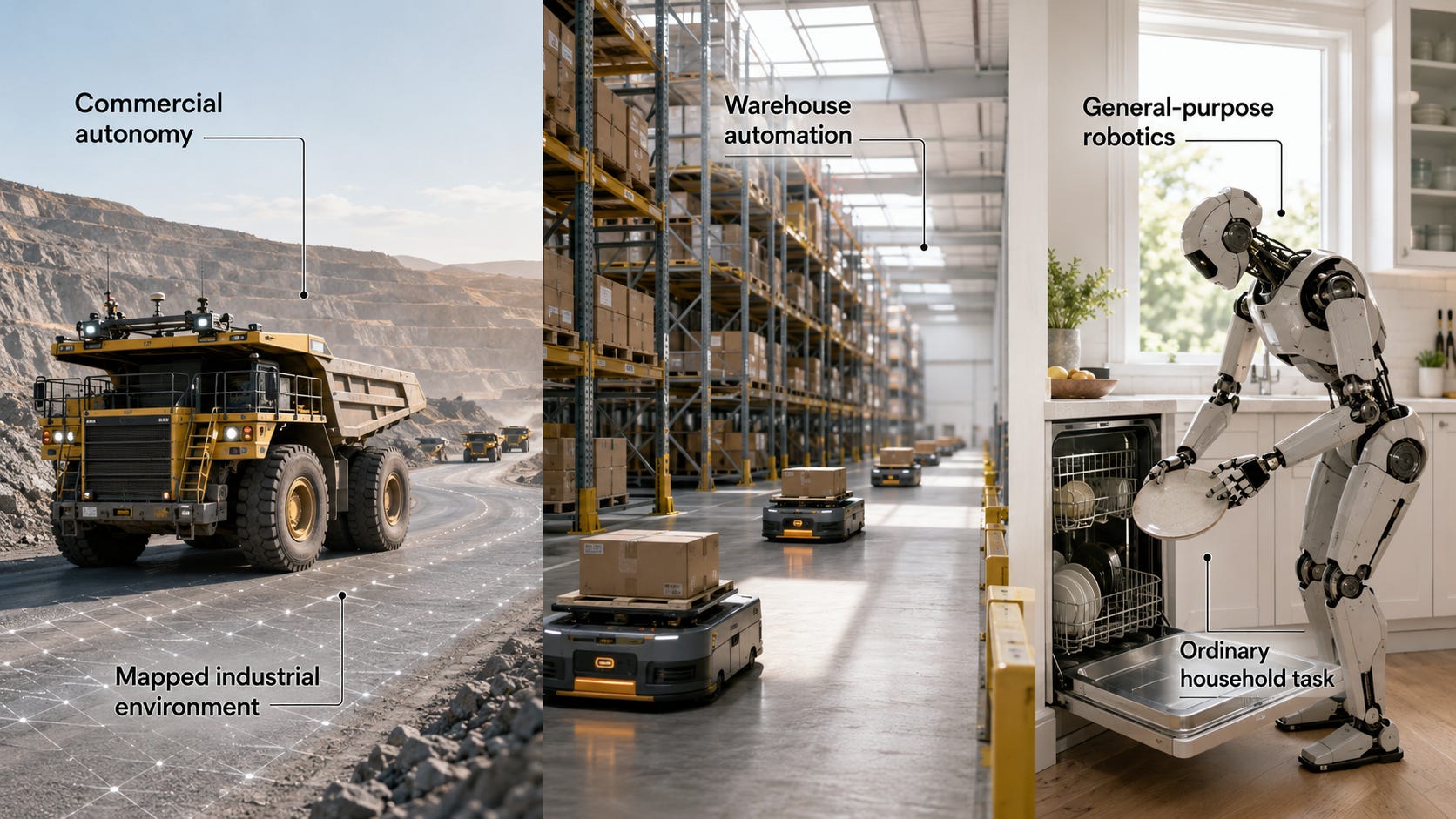
Humanoids are the most visible expression of that ambition. Underneath them, robot skills are moving from programs into models, simulation is becoming a source of experience, world models are entering the control loop, and deployed machines are becoming part of a continuous training system.
Robotics is beginning to resemble computing before a new stack settles. The body, reasoning model, action policy, simulator, safety system and fleet platform can increasingly come from different providers. Nobody yet knows which layer will retain the margin.
The first robotics industry already works
The installed robotics market is much larger than the current humanoid conversation suggests.
The scale becomes clearer when individual applications are placed beside those totals. Amazon has passed one million warehouse robots. Komatsu has commissioned 1,000 autonomous ultra-class haul trucks that have collectively moved more than 11.5 billion tonnes of material. Intuitive Surgical generated more than $10 billion in 2025, supported by 3.15 million da Vinci procedures. Zipline has completed more than 2.5 million commercial deliveries. John Deere’s See & Spray machines covered five million acres while reducing non-residual herbicide use by roughly half.
These systems rarely sell intelligence as a standalone product. They sell an operating outcome.
The robot is one component of a larger operating system.
Traditional industrial automation developed along the same lines. Fixtures hold parts in known positions. PLCs control sequence and interlocks. Machine vision searches for predefined features. CAD models supply geometry. A motion planner finds a feasible route, a trajectory generator converts it into timed joint movement, and real-time controllers keep the arm on course.
This architecture delivers extraordinary repeatability because the difficult uncertainty has already been handled by the system designer.
Its weakness appears when the product, package, gripper or layout changes.
Another round of programming, integration, commissioning and safety assessment begins. The arm may be reusable; the application surrounding it often remains bespoke.
That integration cost is becoming the first target for AI-native robotics, well before a machine can do everything.
Standard Bots is one example of the direction. Its RO1 remains recognisably an industrial six-axis arm, but users can teach tasks through demonstration rather than coding every waypoint and state transition. The immediate opportunity is straightforward: reduce the expertise and time required to deploy machine tending, inspection, pick-and-place and other familiar workflows.
A factory does not need a humanoid to benefit from a robot that learns a new task in hours instead of weeks.
For a large part of the market, the first useful Physical AI metric will be time to useful skill.
Self-driving cars built the first complete learning loop
Autonomous driving offers the clearest preview of where the rest of robotics is heading.
Waymo’s latest company-reported safety analysis covers more than 220 million fully autonomous miles. It reports substantially lower rates of serious and injury-causing crashes than human benchmarks in the same operating areas, while the service completes hundreds of thousands of paid rides each week. The methodology will continue to be scrutinised, but the fleet has reached a scale where safety can be discussed through millions of real journeys rather than selected demonstrations.
https://waymo.com/safety/impact/
The intelligence inside the car is only the visible endpoint.
A robotaxi fuses cameras, lidar and radar; estimates its position; tracks nearby vehicles, cyclists and pedestrians; predicts how they may move; selects a trajectory; and executes it through a real-time control system. Around the vehicle sits a much larger operation: mapping, simulation, rare-event discovery, remote assistance, fleet maintenance, safety evaluation and controlled software deployment.
Every mile can create another test.
An unusual construction layout, reckless driver or flooded road can be extracted from fleet logs and reconstructed in simulation. Engineers can test a revised model against that incident and thousands of previous failures before sending it back to the fleet. Deployment becomes part of model development rather than the stage that follows it.
That loop is key:
operate, observe, find the failures, recreate them, improve the system, validate the change and update the fleet.
It is also the reason why automotive companies keep moving into robotics, it’s basically the same stack.
Tesla already owns large-scale sensing, onboard inference, simulation, manufacturing and over-the-air software deployment. XPeng is developing one Physical AI programme across assisted driving, robotaxis and humanoids, pairing action models with world models that predict how scenes evolve after an action.
Cars and robots remain different physical systems. Manipulation adds contact, self-occlusion, force, deformable materials and tools designed around human hands. Yet the organisational machinery required to improve them is beginning to look similar.
The companies that have already learnt to operate autonomy as a fleet enter robotics with an advantage over teams that have only trained a capable model.
Why the dishwasher is difficult
A long manipulation task compounds small weaknesses.
If a 61-action sequence succeeds 99% of the time at every step, the probability of completing the full sequence without an error is only about 54%. At 95% per action, it falls below 5%.
A kitchen task also combines capabilities that industrial systems traditionally isolate. The robot must navigate, maintain balance, recognise objects from changing viewpoints, remember task progress, coordinate two arms, sense contact and recover when the physical result differs from the intended movement.
The first commercial humanoid deployments are consequently narrow.
Agility Robotics’ Digit has moved more than 100,000 totes at a GXO facility. The job sits close to existing warehouse automation: transfer containers between mobile robots and conveyors, repeatedly, inside a known operation. The humanoid shape allows Digit to work with equipment designed around human dimensions without a major facility redesign. (Agility Robotics)
Figure’s work at BMW is gradually introducing more variation. Its earlier robots accumulated more than 1,250 operating hours and handled over 90,000 parts. The deployment exposed weaknesses in the forearm and informed the next hardware generation. Figure 03 is now tackling components that may be shifted, rotated or partially occluded. (Figure)
Those failures are commercially useful. A pilot that reveals actuator wear, sensor blind spots and intervention patterns can create more value than another flawless demo.
The humanoid form also offers a data advantage. Much of the world’s available physical-behaviour footage was produced by humans, from human viewpoints, using human hands and tools. A robot with similar reach and geometry has a smaller translation problem when learning from first-person video.
The body still has to justify its cost. Wheels consume less energy on flat floors. Fixed arms remain better when the work stays in one place. Quadrupeds suit stairs, rubble and industrial inspection. Drones own the air. Surgical systems follow the geometry of the procedure.
General-purpose intelligence may spread across specialised bodies faster than one universal body spreads across all physical work.
The software beneath the robot
The move into foundation models makes more sense once you understand what was already inside a robot.
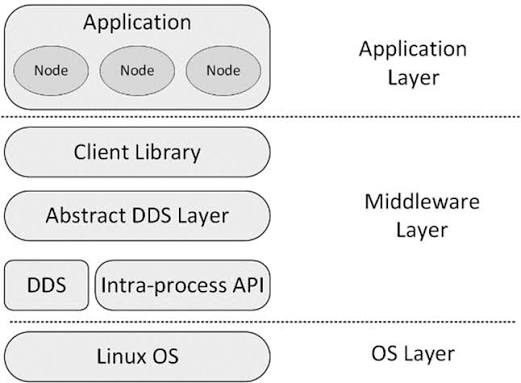
A modern robot is a distributed software system. Cameras, lidar, encoders, inertial sensors and force sensors produce streams of data. Perception software identifies objects and estimates their position. State-estimation and SLAM systems calculate where the machine is. A task planner or behaviour tree selects the next operation. Motion-planning software finds a collision-free path, trajectory generators convert it into time-dependent movement, and fast controllers translate that movement into commands for motors and actuators.
ROS became the common integration language for much of this ecosystem.
ROS rarely owns the final safety decision or the innermost motor loop in a production machine. Industrial cells still rely on OEM robot controllers, real-time firmware, safety PLCs and hard interlocks. Drones often use PX4 and MAVLink. Autonomous vehicles run far more specialised autonomy stacks. The underlying design principle remains similar: isolate sensing, planning, execution and safety so each can be tested and constrained.
This modularity is one reason industrial robotics works as reliably as it does. A position controller does not need to understand what a car door is. A safety PLC does not need to interpret a natural-language instruction. A planner only needs a sufficiently accurate representation of geometry and constraints.
The weakness appears at the interfaces.
A perception system misjudges an object’s pose by two centimetres. The grasp planner chooses the wrong contact point. The motion planner produces a technically valid path to an invalid grasp. The controller executes it perfectly.
Each module has done its job. The robot still fails.
Machine learning first entered this stack one component at a time. Neural networks improved object detection, segmentation and pose estimation. Learned grasp scorers replaced some hand-written heuristics. Reinforcement learning produced locomotion policies and selected manipulation skills. The surrounding architecture largely remained intact, with learned systems inserted where they outperformed classical algorithms.
Foundation models introduced a more ambitious possibility. Instead of improving one module, a sufficiently broad policy could absorb parts of perception, task interpretation, skill selection and action generation into one learned representation.
Enter VLA.
The model moves into the stack
Google’s RT-2 took a Vision-Language Model trained on web-scale images and text and taught it to output robot actions. Position changes, rotations and gripper commands were represented as tokens, allowing the model to generate physical behaviour using much of the same machinery used to generate language. (Google DeepMind)
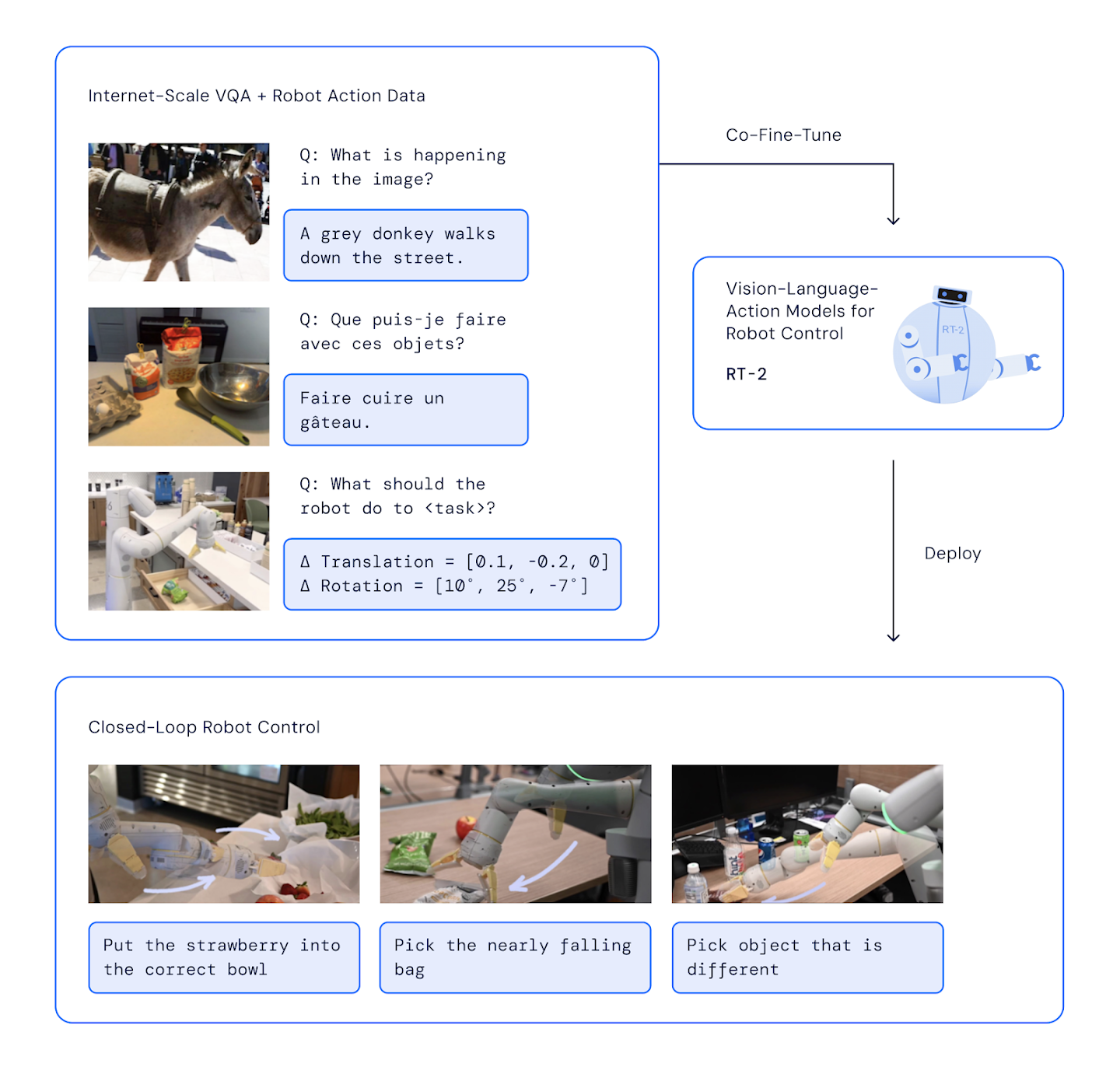
The important inheritance was semantic knowledge.
A task-specific robot policy knows the objects and situations present in its training data. A pretrained multimodal model already possesses useful representations of cups, tools, rubbish, colours and relationships between objects. Robot demonstrations teach the model how those concepts map into movement.
Open X-Embodiment then pooled more than one million episodes across 22 robot types and over 500 skills. Data collected on one embodiment could improve a model used on another, raising the possibility that physical experience might become transferable rather than permanently tied to one machine. (Google DeepMind)
A VLA can enter the robot stack at several depths.
At the highest level, it may interpret an instruction and produce a subgoal such as pick up the blue cup. A conventional planner, MoveIt or another motion system can then calculate the grasp and trajectory.
Further down, the model may directly produce Cartesian targets or short chunks of end-effector movement.
At the lowest level, it can generate joint positions, velocities or even actuator commands, absorbing more of the conventional planning and control system into the learned policy.
The lower the model reaches, the more physical behaviour it can learn directly. It also becomes more dependent on a particular body, sensor arrangement and control frequency. A policy that outputs a body-independent subgoal can travel relatively easily between machines. A policy trained around one robot’s joints, cameras, hand geometry and tactile sensors requires more adaptation.
Where the learned model stops and the conventional stack resumes is therefore both an architectural and commercial decision.
A relatively high boundary supports the horizontal intelligence thesis pursued by Google, Physical Intelligence and Skild: one reasoning or action system can sit above many robot bodies.
A lower boundary supports Figure, 1X, Tesla and other vertically integrated manufacturers. Their sensors, hands, controllers and models are designed together because each determines what the others can do.
Most production systems are likely to settle between those extremes. Foundation models will handle language, unfamiliar objects, task decomposition and adaptable behaviour. Classical or learned controllers will continue to manage the physical loops that demand predictable timing and safety.
ROS 2 still carries sensor data, transforms, robot state, commands, logs and diagnostics between these components. A VLA becomes part of the robot runtime; it does not become the entire runtime.
Physics reorganises the architecture
The first VLA systems inherited the token-based logic of language models. Physical movement made the limitations obvious.
Words are discrete. Robot motion is continuous, highly correlated and time-sensitive. A language model can pause before producing another sentence. A humanoid losing balance cannot. Manipulation policies may generate targets at 50 or 200 Hz, while force, balance and actuator control can run at 1 kHz.
Representing every small joint movement as another token produces long sequences containing large amounts of redundancy. Physical Intelligence’s FAST addresses this by compressing an action trajectory before tokenisation. A discrete cosine transform converts smooth movement into a compact frequency representation, reducing the number of action tokens by roughly an order of magnitude. (Physical Intelligence)
Diffusion and flow-matching policies avoid forcing continuous movement into ordinary next-token prediction. They begin with noise and generate a coherent action trajectory conditioned on the scene, instruction and robot state. This is particularly useful when several grasps or paths could all complete the task successfully.
Action chunking reduces the number of expensive model calls by predicting a short stretch of future movement at once. It creates another timing problem: the robot may finish the current chunk while the next inference is still running. Physical Intelligence’s Real-Time Chunking calculates the next sequence while the machine continues moving, then reconciles the overlap between trajectories. (Physical Intelligence)
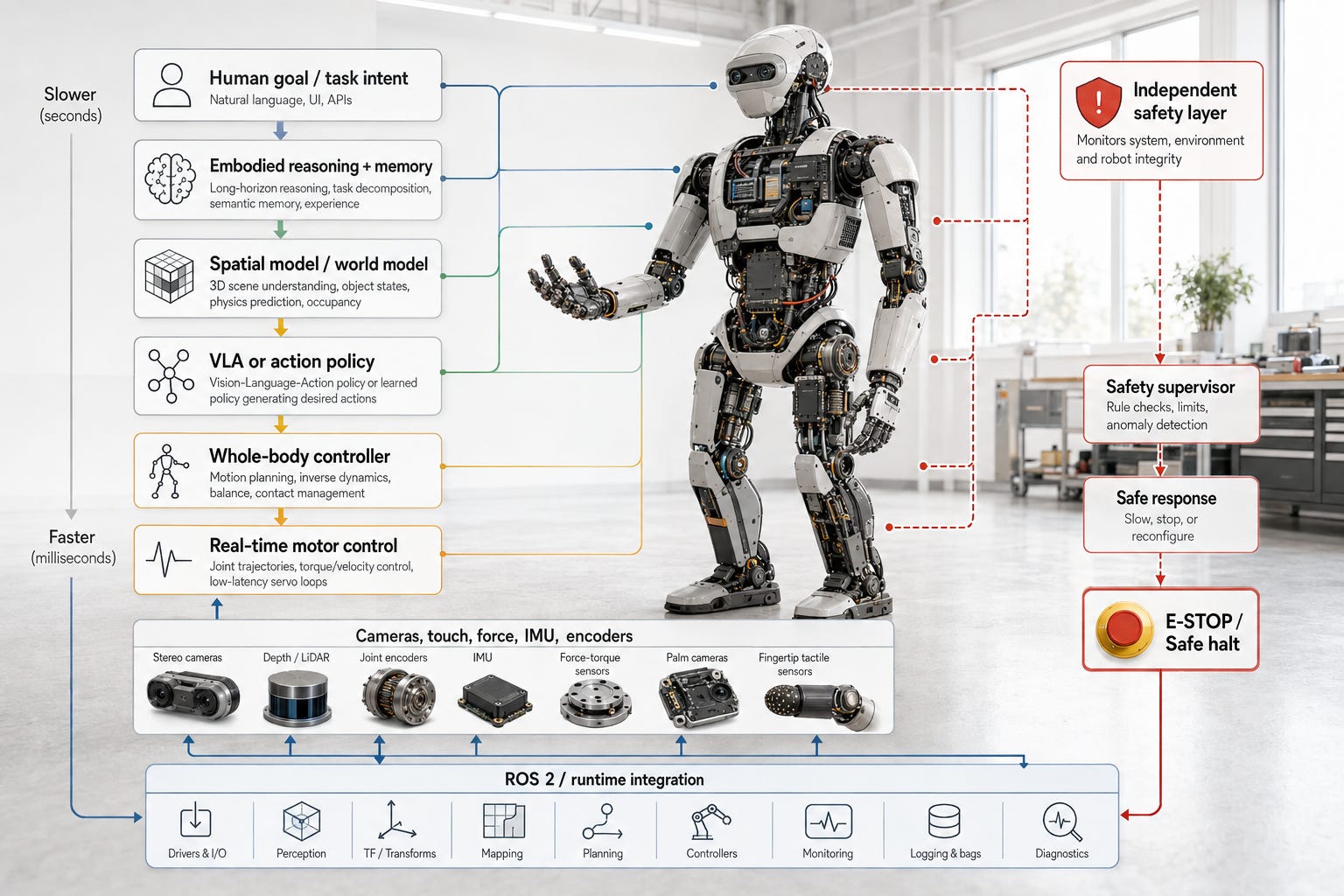
These constraints are producing a recognisable production architecture:
Goal and instruction → embodied reasoning and memory → spatial or predictive model → action policy → trajectory or whole-body controller → actuators
Sensor feedback returns to several points in that chain. An independent safety layer constrains all of them.
Figure’s Helix 02 makes the timing hierarchy explicit. A slower semantic component interprets the scene and goal. A visuomotor policy produces full-body targets at 200 Hz. A 10-million-parameter controller runs at 1 kHz, handling balance, contact and coordination. Head cameras, palm cameras, proprioception and fingertip touch feed different parts of the same system. (Figure)
Google has arrived at a similar separation. Gemini Robotics produces actions, while Gemini Robotics-ER handles spatial reasoning, task decomposition, progress tracking and success detection. Its on-device VLA handles manipulation workloads for which cloud latency, connectivity or privacy would create operational problems. (Google DeepMind)
The old robot stack separated software according to engineering function. The emerging stack is increasingly separated by latency, certainty and physical consequence.
High-level reasoning may take hundreds of milliseconds or seconds. A manipulation policy may generate half a second or a second of movement. A whole-body controller reacts in milliseconds. A safety controller should enforce limits regardless of what the foundation model has inferred.
The result is neither the old modular stack nor one end-to-end neural network. Some legacy modules are being absorbed into learned policies, while new boundaries are forming around timing, embodiment and safety.
A map is not a future
Robotics has always used models of the world.
The new generation of world models is different because the representation is learned from large amounts of visual or physical experience. Instead of predicting only within a hand-written simulator, the model learns statistical regularities in how scenes change over time.
This creates another route into physical intelligence.
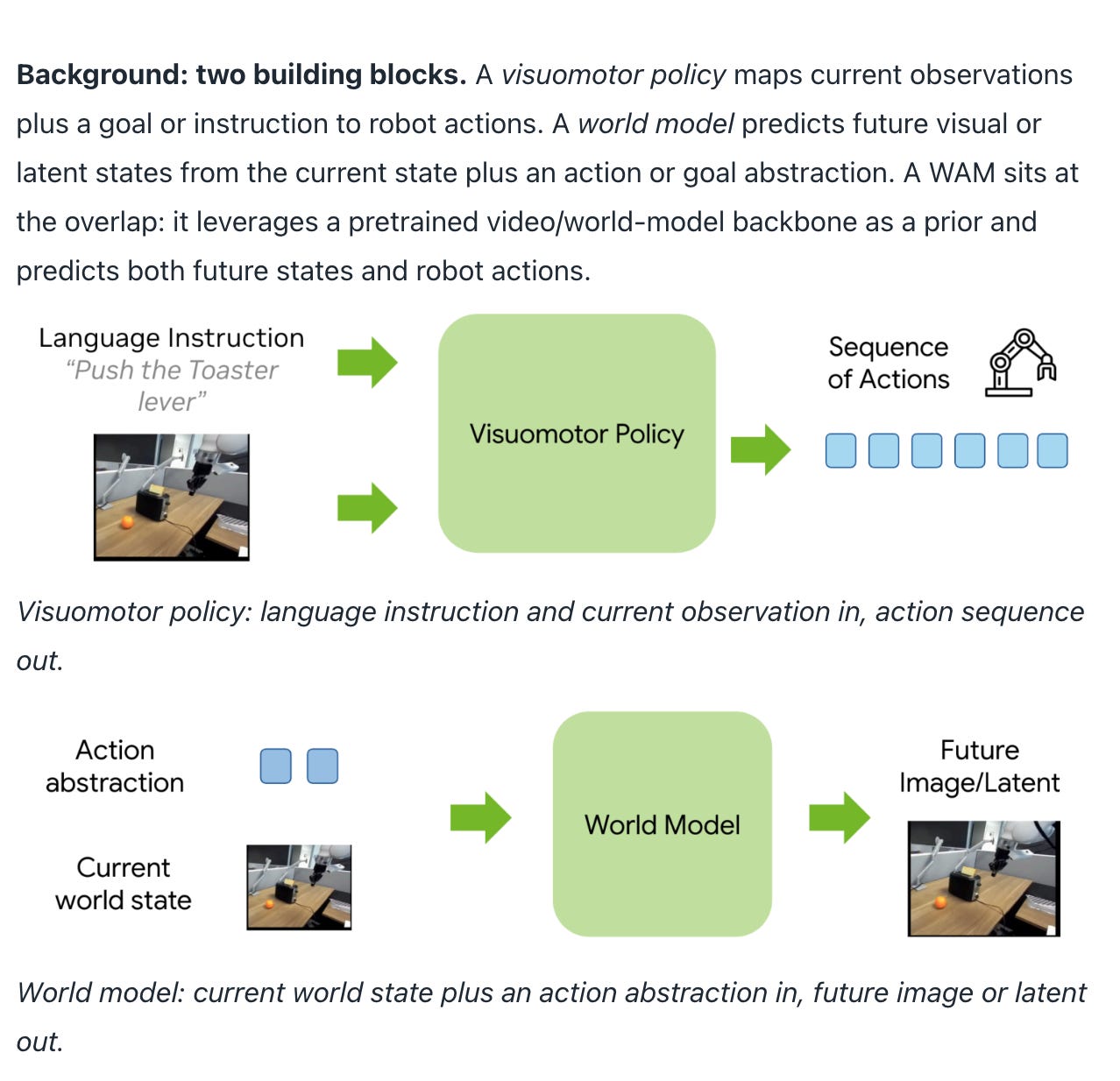
A VLA begins with semantic knowledge from images and language, then learns how instructions map into action. A World Action Model begins with a video or predictive model that has learned something about change, then adapts that representation to robot behaviour. NVIDIA now describes these as two major foundation-model recipes rather than treating WAMs as a proven successor to VLAs. (NVIDIA)
The WAM family contains several architectures.
One approach generates a desired future image or video, then uses an inverse-dynamics model to determine which robot action could create that transition.
Another predicts future observations and actions together, allowing movement and consequence to be generated as parts of the same trajectory. DreamZero and NVIDIA’s forthcoming GR00T N2 move in this direction.
A third uses video pretraining to learn predictive representations, then attaches a faster action policy without rendering a complete future video during every movement.
The potential data advantage is substantial. The internet contains vastly more footage of people opening drawers, handling tools, folding clothes and moving through rooms than it contains robot trajectories. Video pretraining may allow a model to acquire useful physical priors before it sees expensive, embodiment-specific demonstrations.
The compute cost is also substantial. NVIDIA notes that video backbones can involve sequence lengths roughly ten times larger than conventional VLMs and may run several times more slowly at inference. A generated future may look visually convincing while containing the wrong friction, force or contact behaviour. Real-world evidence for general WAM control remains much thinner than the strongest simulation results.
The architecture most likely to reach production will combine them. A semantic model can interpret an instruction and decompose a task. A predictive model can evaluate possible futures. An action policy can generate continuous movement. An embodiment-specific controller can execute it at physical speed.
The software stack now extends beyond the robot
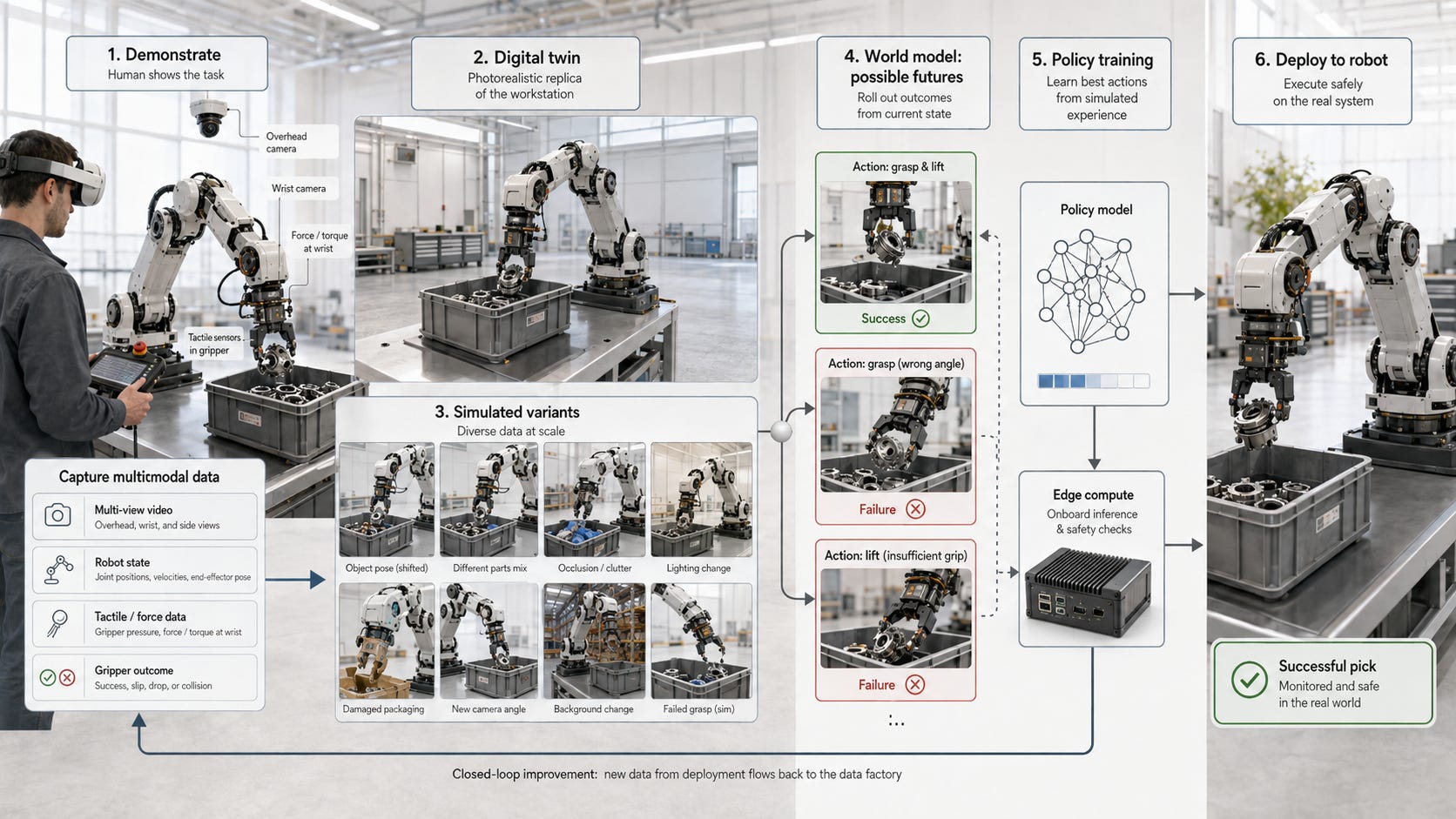
The runtime stack ends at the actuators. The learning stack extends far beyond them.
A person may demonstrate a task through a joystick, VR controller, glove or direct manipulation. ROS bags or equivalent logging systems capture camera frames, joint states, force readings, actions and outcomes. Simulation creates variations and rare failures. Human video expands the range of objects and behaviour represented during pretraining. Deployed robots identify the exceptions that actually matter to customers.
The resulting data passes through curation, training, evaluation and controlled release before returning to the fleet.
Teleoperation plays two roles in this system. It allows a human to recover the customer’s workflow when autonomy fails, while simultaneously creating a labelled example that may reduce the need for intervention later. The economically important measure is the number of robots one operator can supervise and how quickly that ratio improves.
Post-training converts broad capability into operational performance. A foundation model may understand what a connector is and how people normally handle it. Human corrections, reinforcement learning and reward models teach the alignment, speed and force required to insert it reliably on a production line.
Open-source platforms are beginning to standardise this half of the architecture.
Hugging Face’s LeRobot handles datasets, policies, reward models, simulation interfaces and human-in-the-loop training. ROS 2 handles the live processes, devices, messages and control integration. The two ecosystems solve different parts of the problem: LeRobot helps train and evaluate the policy; ROS helps operate it on a machine.
Physical Intelligence’s OpenPI, NVIDIA’s GR00T workflows and Open X-Embodiment widen the pool of models and data. Qwen-RobotManip addresses another structural problem by mapping different robot bodies into a shared state-action representation, masking the joints or grippers that a particular machine does not possess. (Hugging Face) (Qwen)
This common tooling should make robot learning cheaper and more accessible. It will also make individual model architectures easier to reproduce.
The harder capability to copy is the complete operating loop: deployed machines, useful telemetry, human intervention, simulation, evaluation, safety validation and a controlled path for sending improved behaviour back into the field.
But. let’s not forget the OG of all things Robotics. China.
China turns learning into infrastructure
China begins with a physical base no other country currently matches.
It operates more than two million industrial robots and accounted for 54% of global factory installations. Domestic manufacturers captured 57% of the Chinese market, roughly double their share a decade earlier. The result is a dense ecosystem of motors, reducers, batteries, sensors, controllers, actuators and robot hands.
The model ecosystem is developing alongside the hardware.
Alibaba has Qwen models for manipulation, navigation and world prediction. Tencent’s Tairos separates perception, embodied reasoning and action. ByteDance combines web data, human VR demonstrations and robot trajectories. XPeng brings autonomous-driving data, chips and simulation into humanoids. AgiBot is building bodies, datasets, foundation models and world-model infrastructure inside one organisation.
China’s most distinctive move is the construction of shared robot-training facilities.
Beijing centres operate more than 100 robots across reconstructed workshops, homes and care environments. Larger facilities run multiple robot types through varied industrial and household scenarios, resetting scenes to generate new combinations rather than replaying one memorised sequence.
This changes the order in which the ecosystem develops.
A Silicon Valley foundation-model company often begins with research talent and capital, builds a proprietary data operation, wins a small number of deployments and then attempts to create a feedback loop.
China can combine component suppliers, lower-cost bodies, factories, training centres and domestic model teams much earlier. Hardware, deployment and data collection grow together.
The familiar shorthand of American brains and Chinese bodies is obsolete. Both ecosystems are building the full system, although their starting advantages remain different.
The United States concentrates frontier research, software infrastructure, venture capital and mature autonomy fleets. China combines manufacturing depth, deployment volume and coordinated physical infrastructure. Japan and Europe retain industrial incumbents, precision components, safety expertise, integrator networks and customer trust.
The competition is moving from individual robots to entire learning systems.
My bet: the workflow wins before the universal robot
Robotics companies raised a record $40.7 billion in 2025, according to CB Insights. Autonomous driving attracted the largest rounds, while humanoids and robot foundation-model companies drew a growing share of activity. (CB Insights)
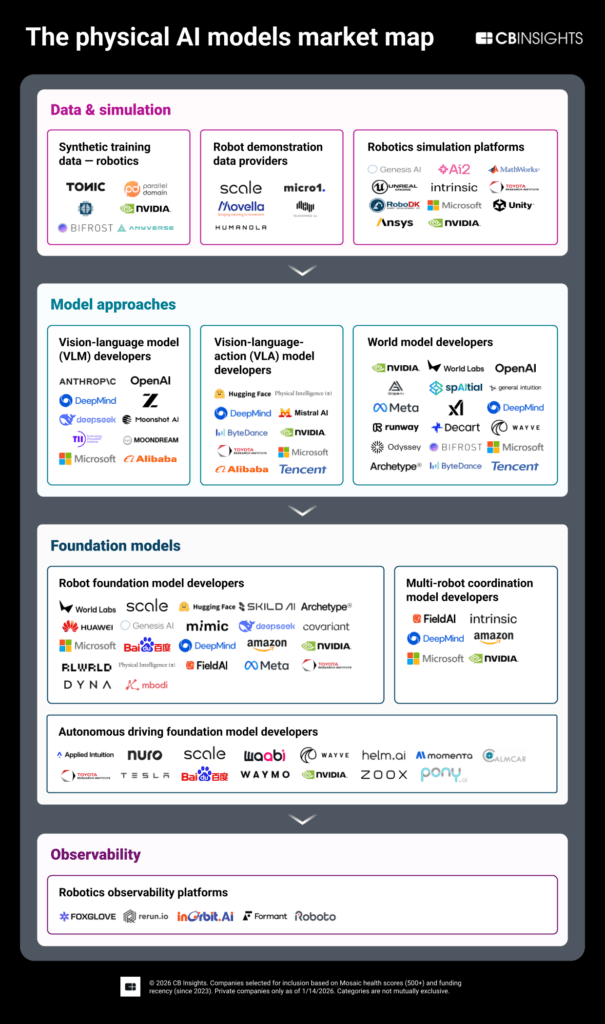
Capital is funding several futures at once.
Figure and 1X want to own the body, model, data operation and deployment relationship. Physical Intelligence, Skild and Google want intelligence that travels across hardware. NVIDIA wants the simulation, training and edge-compute substrate beneath both. Industrial incumbents bring installed bases, safety certifications, integrator networks, spare parts and customer access.
My view is that the market is currently overestimating the near-term value of a standalone general-purpose robot brain and underestimating the value of workflow ownership.
Over the next three to five years, the strongest businesses will combine increasingly general intelligence with a deliberately narrow commercial starting point.
They will automate one economically valuable workflow, operate it at high utilisation, collect the exceptions, improve the policy and then expand into adjacent work. The machine may be humanoid, wheeled, fixed or quadrupedal. Its first shape will be determined by the workflow rather than by a philosophical commitment to human form.
Factories and warehouses will move first because they offer repeat volume, measurable labour value, controlled access and two- or three-shift utilisation. Inspection, agriculture, mining and selected healthcare workflows will continue scaling for similar reasons.
Homes will take longer. The environment is broader, the safety expectations are higher, utilisation is lower and household willingness to tolerate remote intervention remains uncertain. A home may contain the largest task universe, but it is a difficult place to amortise expensive hardware.
I also expect the dominant architecture to remain hybrid.
Semantic reasoning will increasingly come from multimodal foundation models. World models will contribute predictive representations and synthetic data. Fast action policies will generate trajectories. Embodiment-specific controllers will handle contact and stability. Deterministic systems will retain authority over hard safety constraints.
VLA and WAM will become less useful as opposing labels. Production stacks will borrow from both.
The model layer will also become more open than many current valuations assume. LeRobot, OpenPI, GR00T, Qwen and future open models will reduce the cost of competent baseline intelligence. Chinese manufacturing will compress the cost of bodies and components. Neither pressure eliminates differentiation; it pushes differentiation towards harder assets.
Those assets are deployment access, workflow integration, safety evidence, remote operations, field service and the ability to improve a fleet without breaking what already works.
NVIDIA is well positioned because almost every architecture increases demand for simulation, training and edge compute. Incumbent robot companies are better positioned than the current AI narrative suggests because they already own distribution, certification and maintenance. Frontier model companies will need operating access, either through vertical integration, OEM partnerships or acquisitions.
The likely winner will look less like a pure model laboratory and more like an AI company fused with an industrial operator.

Start with the job, not the robot
A company entering Physical AI should not begin by asking where it can deploy a humanoid.
It should begin with a workflow.
The best initial workflow sits between traditional automation and unstructured labour. It has enough repetition to generate volume, enough variation to make AI useful, sufficient labour or downtime cost to fund the system, and a safe fallback when the machine encounters something outside its operating envelope.
The first design decision should define the operating envelope. What objects, layouts, lighting, payloads and human interactions has the system actually been tested against? Which situations trigger a retry, remote assistance or a safe stop?
The second should define the learning architecture. Who owns the camera streams, force data, intervention logs and resulting training data? Can failures be reconstructed in simulation? How are policy updates evaluated against previous tasks? How quickly can a useful correction reach the fleet?
The third should define the commercial metric. Robot counts and successful demonstrations are weak measures. Productive autonomy should be measured through completed work, intervention minutes, autonomous recovery, cycle time, uptime, energy, maintenance and total cost per successful task.
The fourth should preserve architectural leverage. A customer should understand which parts of the system are proprietary, which interfaces are portable and where a vendor could create lock-in across data, models, fleet management or maintenance.
I would favour outcome-based or Robot-as-a-Service structures for immature categories because they force the vendor to absorb the relationship between model performance and field economics. When the provider is paid for completed work, hardware reliability, supervision, inference cost and maintenance become one P&L.
That is a healthier test than buying a fleet of robots and hoping the promised autonomy arrives later.
The companies that learn this operating discipline early will have an advantage when the models improve. They will already own the workflow, data and customer relationship through which better intelligence becomes revenue.
The second deployment
The decisive event in Physical AI will probably arrive as an ordinary incident log.
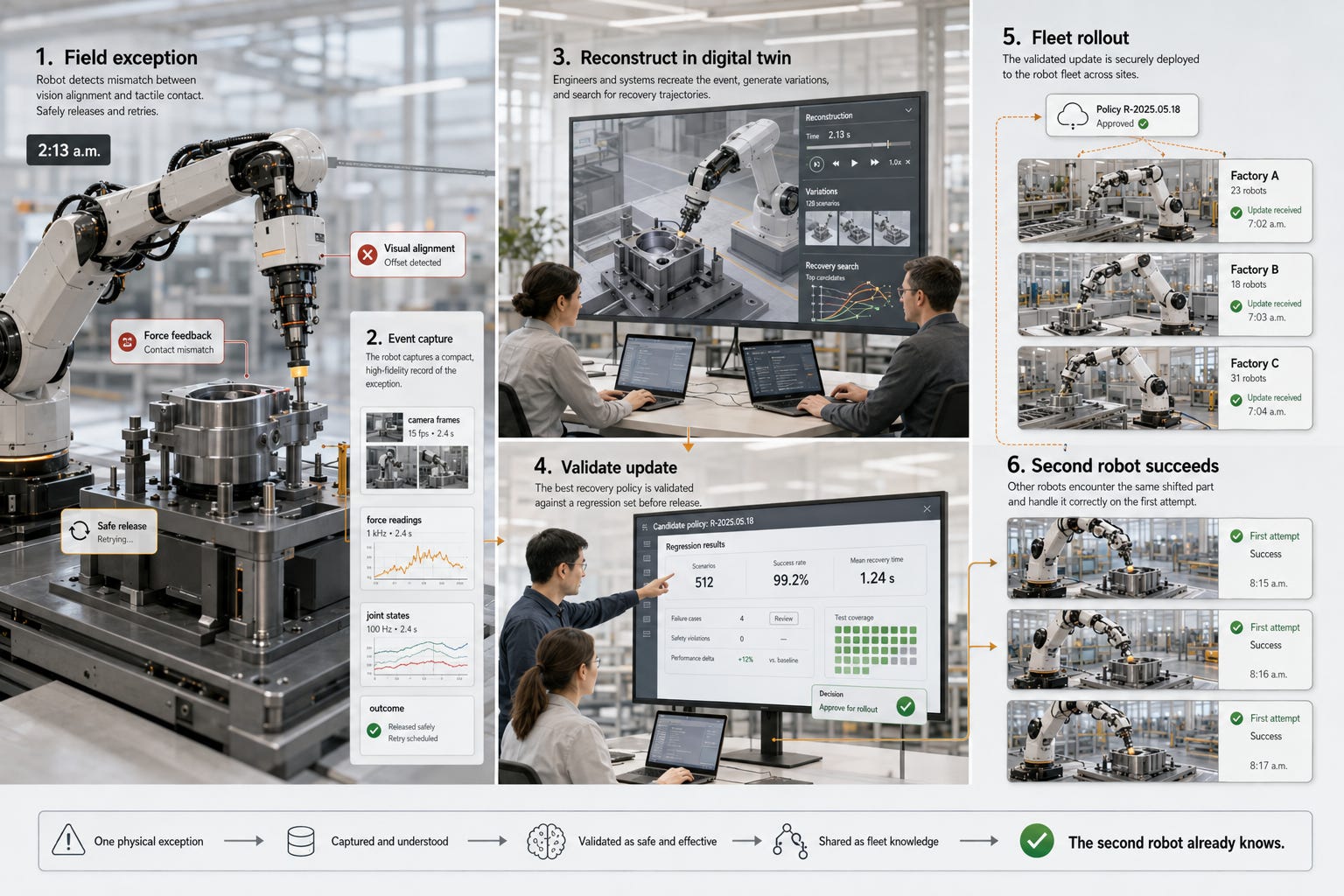
At 2:13 in the morning, a robot reaches for a component that shifted during transport. The camera suggests the grasp is correct, but the tactile signal disagrees. The machine releases the part before damaging it, changes its approach and completes the operation.
The episode is stored with the images, forces, joint states, actions and outcome. Engineers replay it in simulation and generate related cases. A reward model scores the recoveries. The revised policy is tested against earlier behaviours and released to the compatible fleet.
The first robot encountered the exception.
The second begins its shift with the correction already installed.
The second factory should take less time to integrate. The third customer should receive the recovery policy without recreating the failure. One remote operator should gradually supervise more machines. The same hardware should acquire more useful work without another round of bespoke engineering.
Autonomy already works inside domains that companies have spent years designing, mapping and operating. Physical AI is widening those domains and making physical capability increasingly transferable.
The next decade will produce better bodies, better models and much better simulations. All three will become more available.
The durable advantage will belong to the organisation whose next deployment arrives with every lesson from the previous one already embedded.

Join the conversation