
Imagine a UAE telecom operator deciding where to invest its next dirham in AI. A national alarm centre, a retailer with 400 cameras and a family choosing a mobile plan have little in common as AI customers. The alarm centre wants a duty officer to see the right evidence in time. The retailer wants to add a capability to equipment it already owns. The family wants an answer it can check against next month’s bill. Calling all three opportunities “AI services” tells an operator remarkably little about what to build.
I would start with the customer promise in each business and work backwards to the parts a telecom operator can credibly own. That leads to eleven distinct strategies. Some can earn revenue directly. Others justify their cost by making several businesses cheaper or more reliable to run. The distinction matters when the same investment committee is being asked to fund both a fleet of GPUs and a consumer assistant.
1. A national safety agent for the Signal Receiving Centre
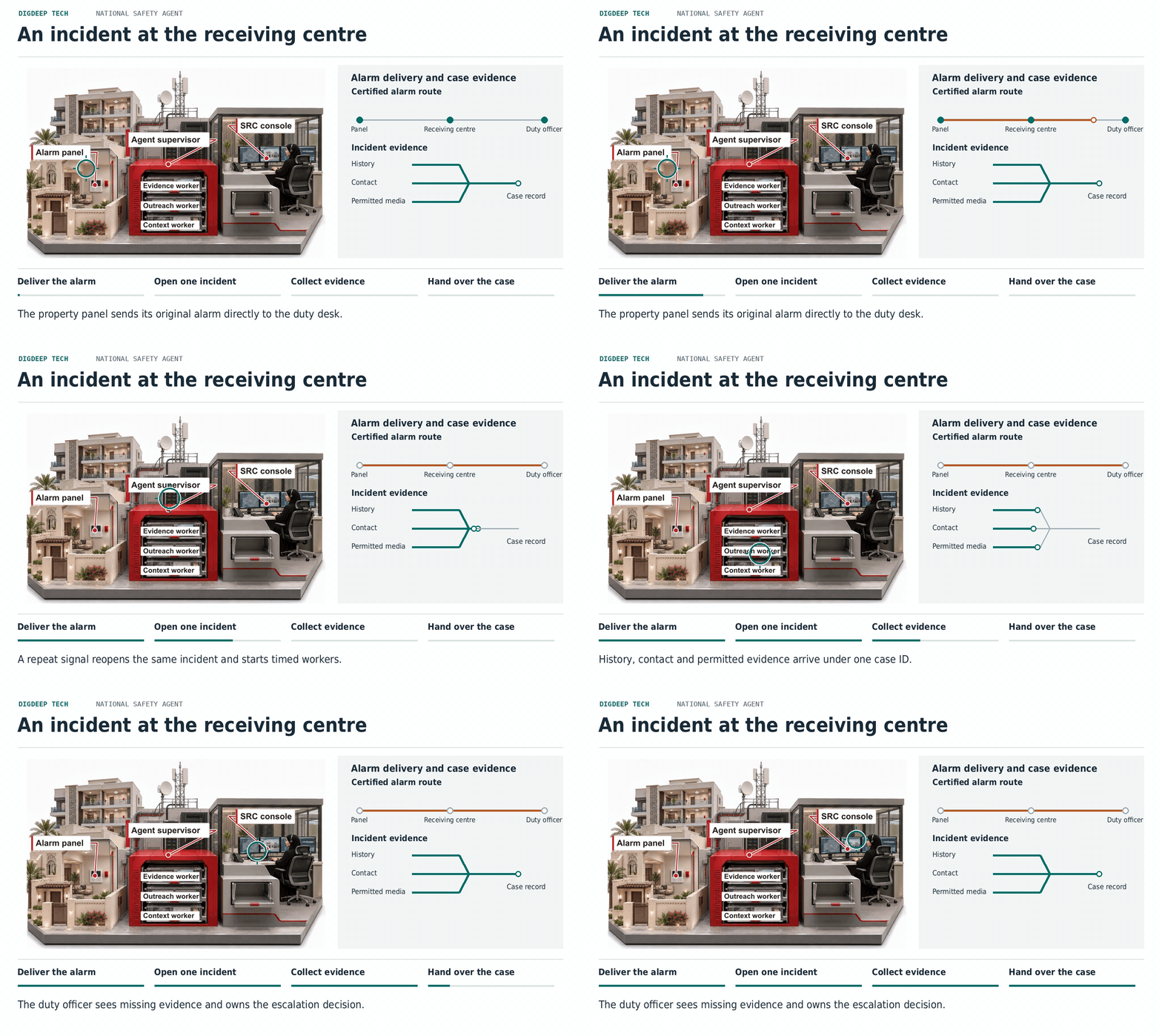
A second signal from the same property can mean the situation has changed. It can also mean the panel has repeated the original alarm. A duty officer needs to see both signals, their order and what anyone has verified so far. In a national monitoring service, I would make that incident record the centre of the AI proposition.
There are two clocks in the receiving centre. The first starts with the panel alarm. Its site, device and alarm identifiers reach the duty desk through the existing certified route. The second starts when a copy of the event opens an assistance case. A durable workflow engine such as Temporal can retain that case through a restart. Repeated deliveries attach to the open incident. A genuinely new observation gets its own timestamp. Each worker has a deadline so the officer can see when information is still outstanding.
The evidence gateway is the boundary between the workers and the underlying records. A history worker can read the relevant property record. A contact worker can log an unanswered call. A media worker can request a time-limited reference to permitted evidence. A UAE-hosted model may summarise a finding with its source, observation time and confidence. A policy engine such as Open Policy Agent checks the role, purpose and consent before a broker issues a short-lived credential for any further action. The action ledger then links the officer’s decision and the receiving authority’s reference to the original alarm. That chain lets a supervisor replay a difficult incident with the evidence that was actually available at the time.

The buyer is a monitoring organisation responsible for the quality of the handover. Its acceptance test should include repeated signals, a resident who cannot be reached, conflicting evidence and a model outage. Replay those incidents with experienced duty officers, then run the service alongside existing operations. I would price coverage per monitored site and review missed incidents, unnecessary escalations and time to a usable handover together. Rewarding the supplier for fewer escalations alone would give it the wrong incentive.
2. Managed computer vision across the camera estate
A retailer with 400 cameras is unlikely to replace its recording system to try one new analytic. The commercially interesting offer is to activate a module on 20 existing cameras, agree how to judge its output and expand if the operating team uses it.
A camera that moves a few degrees after maintenance can create an expensive stream of false alerts. The owner of the analytic needs the authority to diagnose that change and the means to distribute a fix.
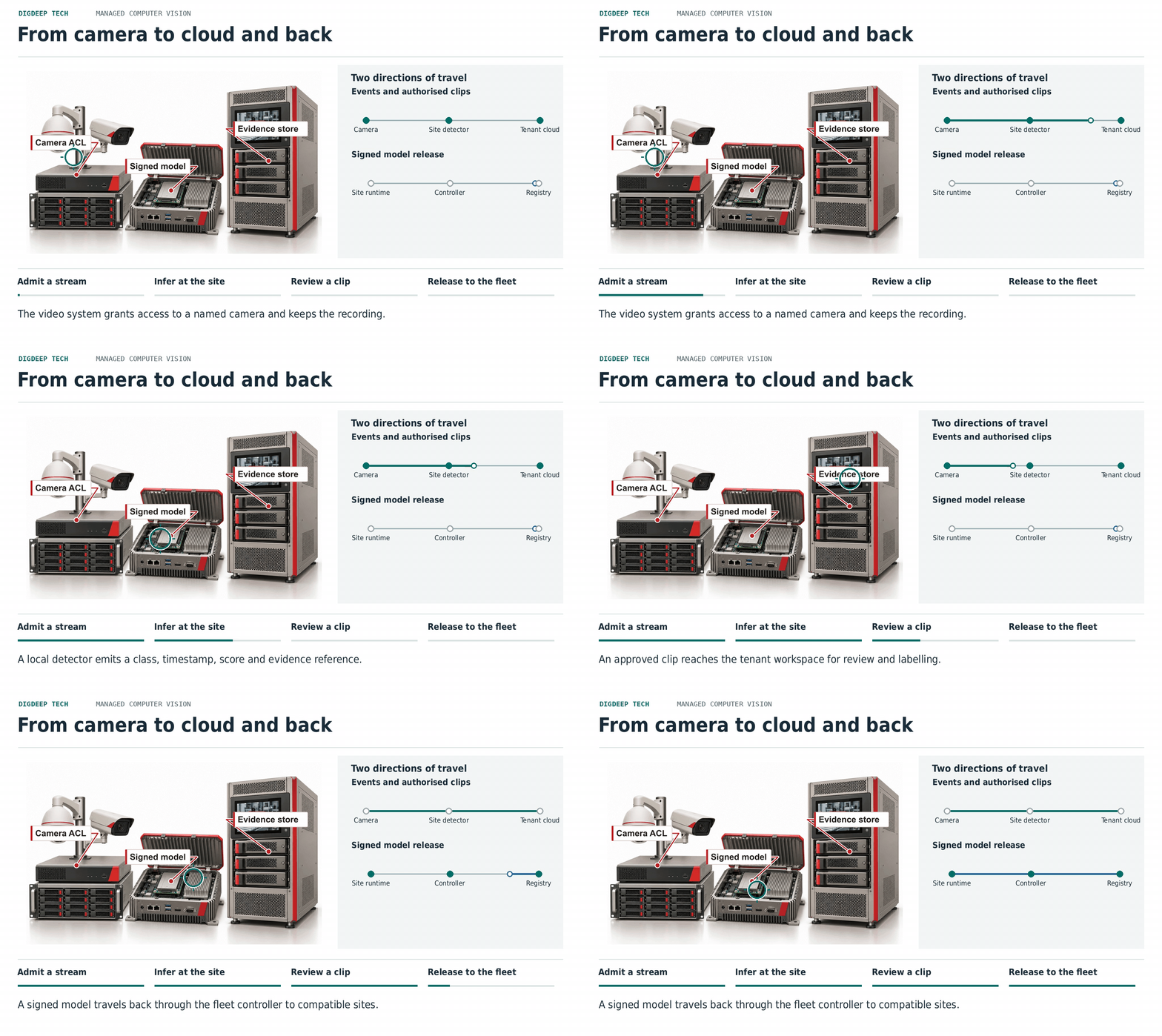
Follow a single camera rather than the entire estate. Its video management system owns the recording, user permissions and retention period. The adapter assigns a stable camera ID, maps the authorised stream and produces a time-limited pointer for a permitted clip. At the site, a decoding and tracking pipeline runs an inference engine compiled for the target camera, neural processing unit or GPU. The event leaving the site contains a time, class, score and evidence ID. Centrally storing a second copy of the recording would add cost and another access boundary.
The cloud side has two stores and a return journey. An event bus such as Kafka carries detections into tenant-scoped search. Object storage holds separately authorised clips for labelling or vision-language review. A team can register its revised detector in MLflow, package the runtime and weights as a signed OCI container, then release it to a compatible hardware cohort. The controller checks the digest actually running alongside latency, dropped frames and error rates. A faulty release can be rolled back without revoking the camera’s recording service.

The second half of this business is keeping the analytic useful after installation. A camera moves. Lighting changes. A model that works on a site GPU may drop frames on a smaller device. Quote a recurring fee per active camera and analytic, with custom training separately priced. Review false alerts and a sample of missed events with the buyer. That conversation establishes whether the next 380 cameras are a sale worth making.
3. Managed edge AI at the customer site
A branch gateway, an industrial computer and a site GPU server serve different buyers. A branch may need a few sensor and video streams. An industrial site may need rugged inputs and local storage through an outage. A large site may need several models in memory at once. The operator should qualify all three against real workloads before publishing its hardware catalogue.
The buyer gets one support number. Behind it, someone still has to distinguish a circuit problem from a failed runtime or a model that has stopped recognising the event it was bought to detect.
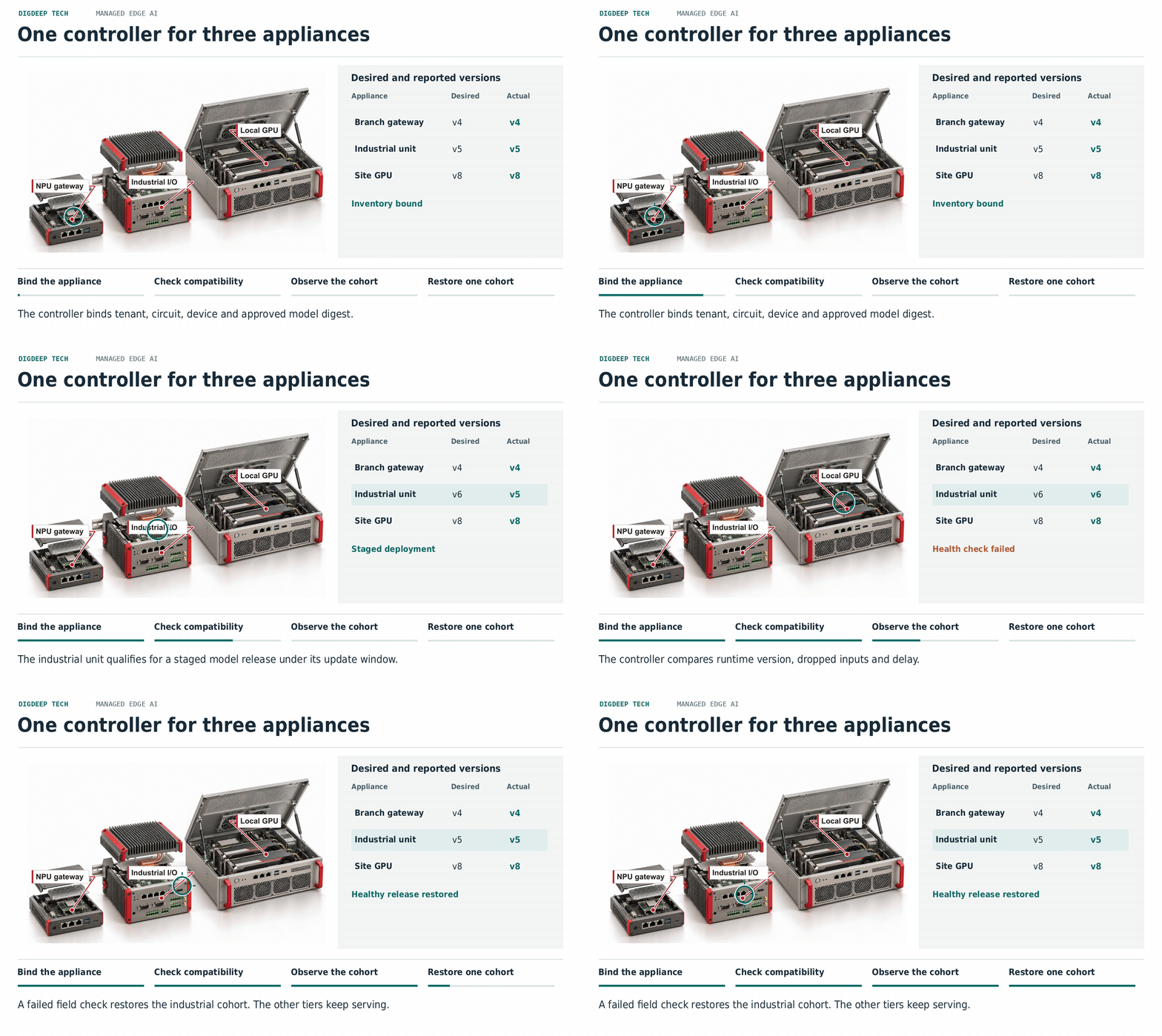
The entry gateway could start around the 50-TOPS class for a bounded set of camera streams and sensor events. A 100-TOPS-class industrial device would trade up to the required field interfaces, thermal headroom and local storage. A site GPU server is the third tier. Its limiting dimension might be memory for several resident models, decoder capacity or the number of streams that can meet a latency target. TOPS measures an accelerator’s nominal operations per second. A buyer needs a qualification result for the actual model, precision, input rate and ambient conditions.
The fleet controller turns those boxes into one service. Its desired-state record binds tenant, site, circuit, hardware profile, approved model digest and update window. A device agent reports the active digest, temperature, inference delay and dropped inputs. The controller compares desired and actual state, checks memory and signature compatibility, then promotes or restores the tested cohort. Local buffering and a known-good model allow the agreed workload to continue through a disconnection. When the link returns, the controller reconciles what the device ran with what operations expected.

Sell a managed site with connectivity, a qualified appliance and a supported workload. Network operations owns the line, platform operations owns the runtime, and the model owner signs off on field quality. For pricing, the most revealing spreadsheet row may be the cost of a second technician visit. Include spares, replacement time and support labour before calling a low-cost appliance the better deal.
4. Shared inference for robot and drone fleets
A mobile inspection robot can wait for a second opinion on a partly obscured equipment label. It cannot wait for a distant server to decide whether to stop. That difference defines the role a carrier exchange could play in physical AI.
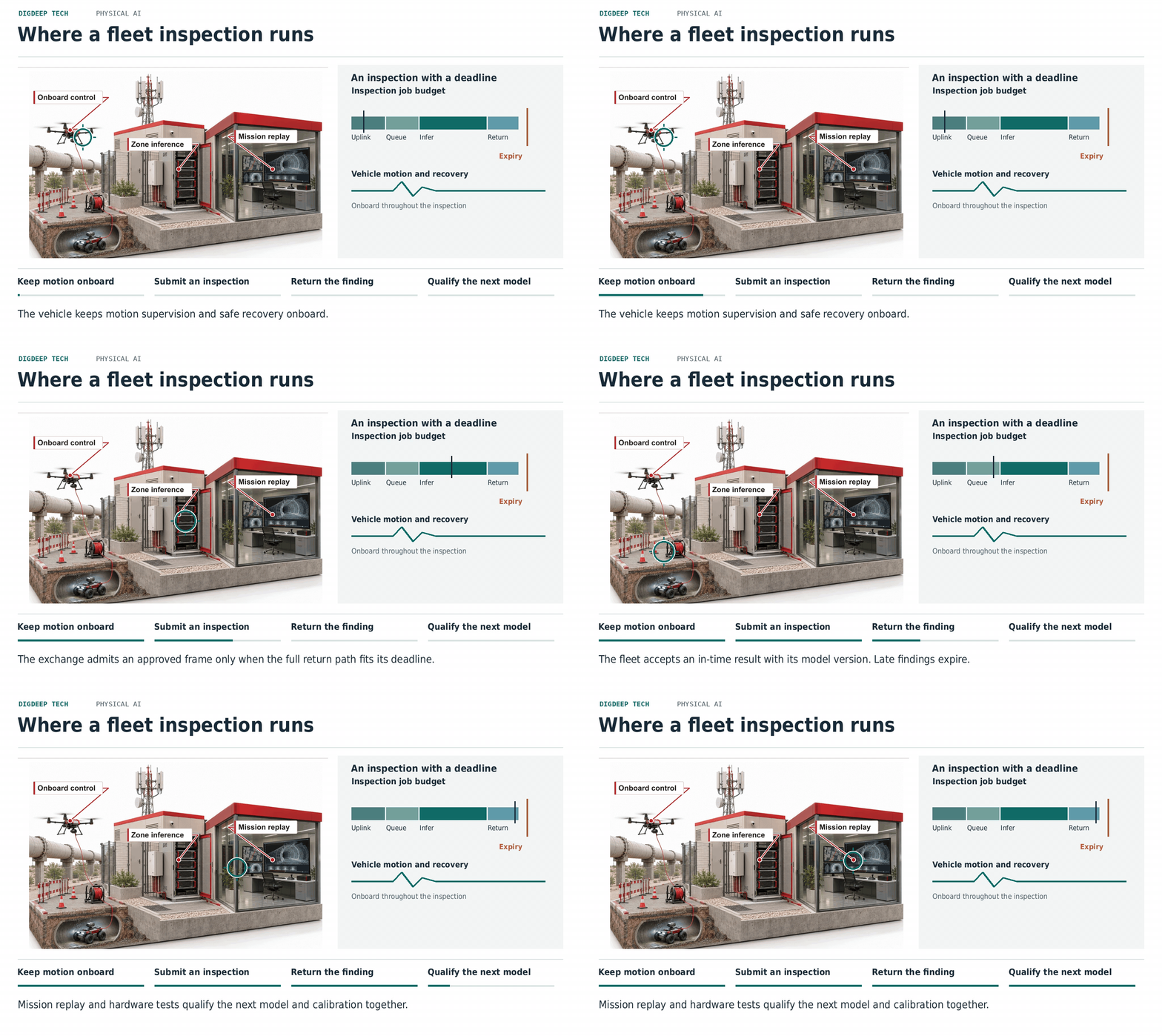
A fleet operator should be able to point to three separate places on its architecture. On the vehicle, ROS 2 sensor streams and onboard perception feed the motion supervisor. On an exchange GPU, an inspection service accepts a mission ID, permitted frame, model class, data zone and result expiry. In the regional workspace, the mission ledger joins the original work request to its evidence, model version and accepted finding. A vision-language-action model may suggest the next inspection skill. The vehicle checks that the skill is permitted and within its operating bounds.
Placement is a deadline calculation. A short inference time is of little use after a congested uplink or a long queue. The scheduler needs a budget for uplink, waiting, processing and return. The fleet can discard an expired finding using the original mission ID. Recorded sensor runs then become a qualification set for the regional team. It can replay the difficult cases in simulation, test on the target hardware and release the signed model with its matching calibration. A fleet buying the service can check which version actually produced a finding.

Dubai South has described plans for robotic inventory counting at a logistics facility. Dubai Future Labs’ indoor delivery programme aims to make 100 buildings robot-ready by 2029. An end-of-shift inventory count and a robot waiting for a lift have different tolerances for delay. I would secure one paying fleet, measure the actual arrival pattern of jobs, and compare an exchange with dedicated site hardware on cost per accepted result. Sell reserved capacity plus usage where sharing the exchange has a measurable advantage. Dubai South announcement · Indoor delivery programme
5. GPU capacity backed by contracted demand
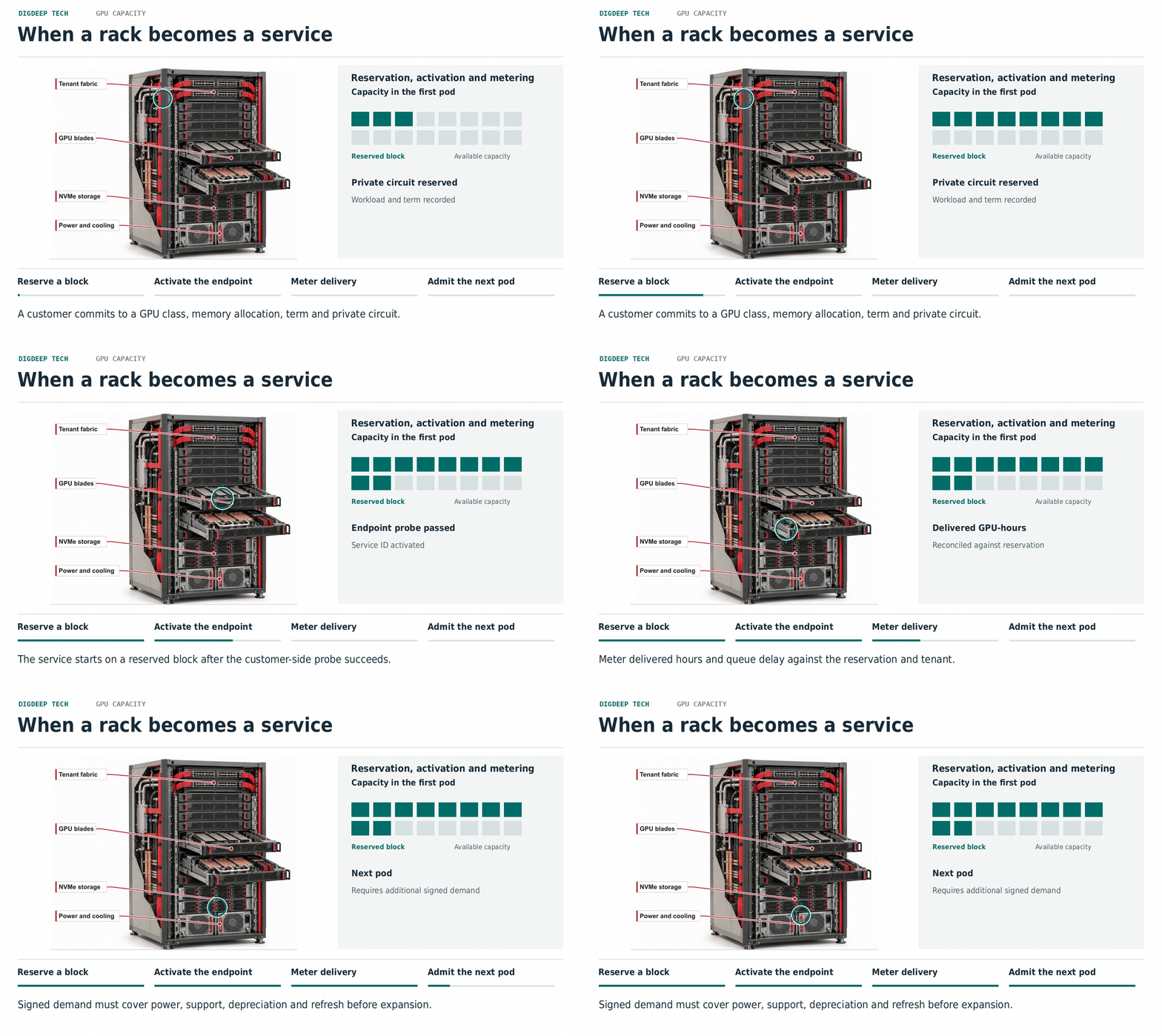
A customer reserving a private inference endpoint for a year and a team training a model for three weeks might ask for the same accelerator. They are buying different commitments. Before procuring a rack, specify the memory, quantity, term, private circuit, queue limit and recovery arrangement the customer will pay for.
Inside the rack, the tenant fabric connects accelerator blades and local NVMe storage. Electrical capacity, cooling, network throughput and the recovery allocation determine what portion of nominal GPU capacity is sellable. At admission, the order specifies accelerator type, memory, quantity, term, private circuit and recovery requirement. A shared queue can use Kueue to admit work against quota. A dedicated batch pool can use Slurm. An interactive endpoint and a long-running training job should have explicit scheduling and interruption terms.
At the serving layer, a versioned runtime such as vLLM exposes the model behind a private endpoint. An external probe exercises it from the customer side before billing starts. Device telemetry, job admission times and completed requests are joined to its service ID. Finance can then sell a dedicated node-month, reserved or on-demand GPU-hours, or managed inference billed by token or accepted request. As a market reference, Lambda lists US$6.16 per GPU-hour for a 16-GPU H100 term cluster. A UAE quote must separately account for private connectivity, support, recovery and residency. The scope of each quote matters more than a headline hourly comparison. GPU cluster pricing

Consider a deliberately simple investment case. At AED 240,000 in monthly fixed ownership costs and AED 12 contribution per delivered GPU-hour after variable costs, break-even is 20,000 billable hours per month. Those are illustrative figures. The test is whether contracted jobs fit the hours the pod can deliver after maintenance, recovery headroom and peak demand. I would rent capacity for uncertain demand and commission the next pod when signed commitments cover power, support, depreciation and refresh.
6. The company-wide AI product catalogue
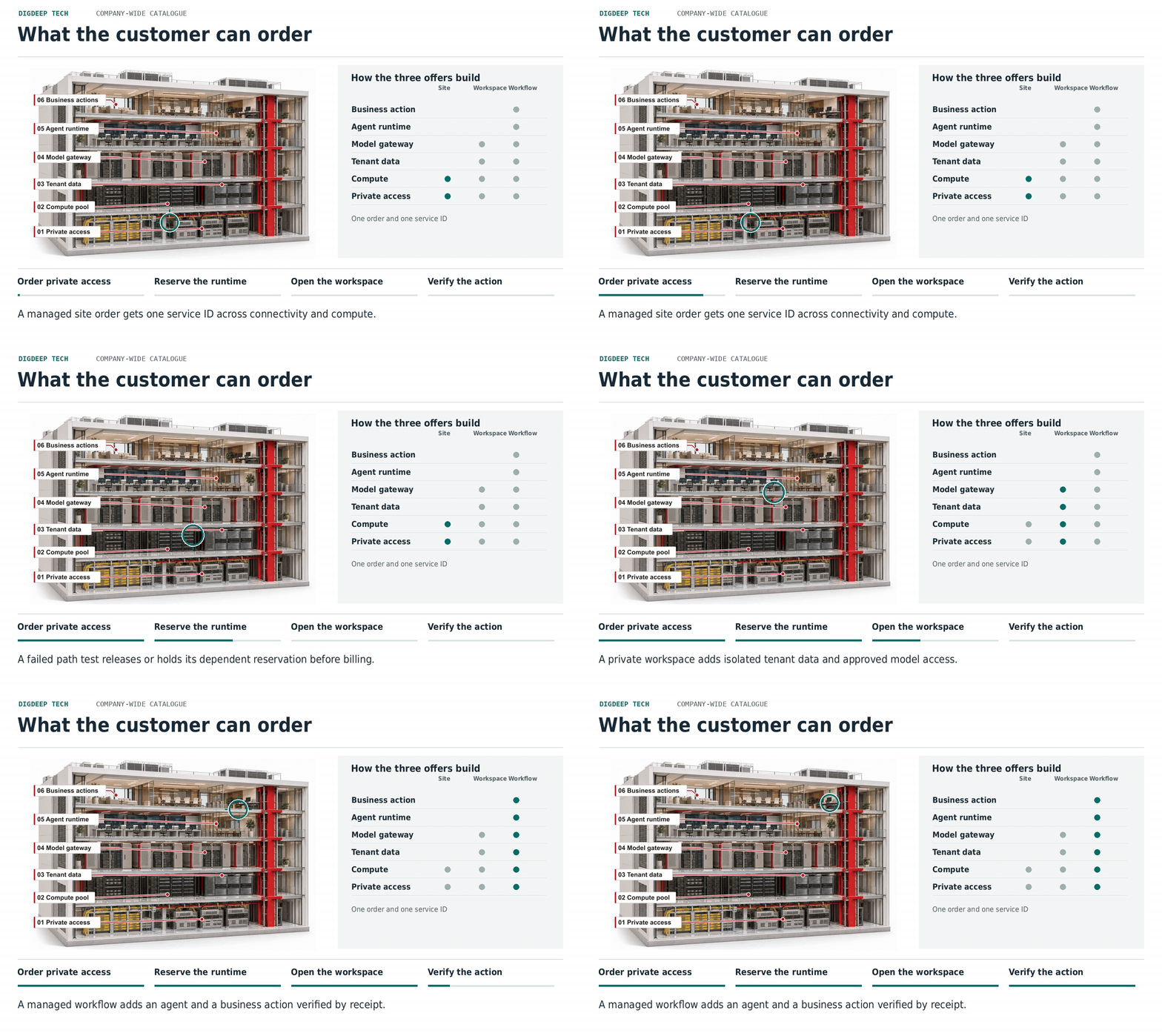
For an enterprise account director, “we have edge, cloud and agents” is a difficult proposition to quote. I would give the sales team three offers. A managed AI site combines private access and a supported local workload. A private workspace adds isolated data and approved model serving. A managed workflow adds authority to perform a named business action and verify it in the customer’s system.
Read the stack from the service entrance upward. Private access supplies a dedicated circuit, tenant network and, where contracted, diverse paths. Compute reserves capacity at the customer site, a metro exchange or a UAE accelerator pool. The operator can source qualified sovereign capacity through a partner and retain responsibility for the customer’s service ID. Tenant data brings together event streams, object storage and retrieval indexes. Access rights, encryption keys and retention rules must survive each transformation.
The model gateway selects an endpoint allowed for the tenant, model and data class. It can serve approved open weights locally or use a separately authorised frontier endpoint for eligible requests. Agent orchestration preserves the case, limits workers and records each authorised tool call. Business action is the final layer. An enterprise resource planning update, subscriber order or closed case returns a receipt. The service controller reserves dependencies in order, probes the endpoint and unwinds orphaned reservations after a failed order. That is how six technical layers become a single accountable sale.

An enterprise can buy the first offer without commissioning the third. Account teams can price the additional responsibility at each step. Finance can compare contribution after field service, reserved capacity, inference and integration. The commercial question is how often customers buy the next level because it solves an additional problem.
7. Agent orchestration from intent to receipt
A model’s proposed action and a completed customer transaction are different events. A shared agent platform must account for everything that happens between them. Start each case with an identified tenant, purpose, budget and set of software versions. Keep its state when a worker times out or a supervisor does not respond until the next shift.
Take a service order that succeeds just as the customer’s connection drops. The financial risk sits between the completed write and the missing acknowledgement. Repeating the order could charge the customer twice.
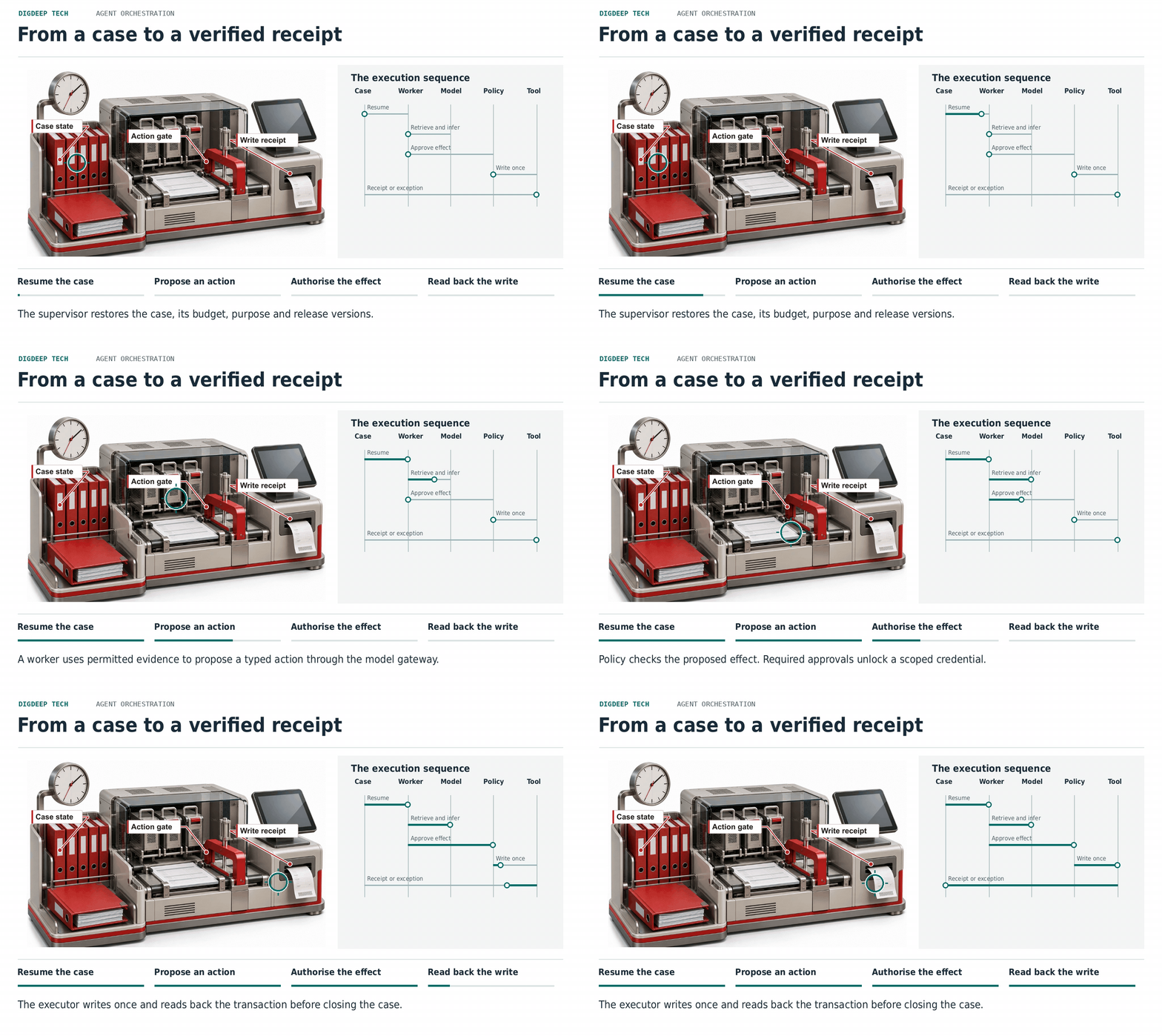
In an implementable runtime, the case supervisor, worker harness, model gateway, policy gate and executor are five different participants. Temporal can own case timers, worker results and approval signals. A worker gets a bounded model turn over tenant-scoped context. A typed schema validator such as Pydantic checks the proposed tool arguments. The model gateway records which model and prompt produced them. The policy gate then checks whether this worker may cause the proposed effect for this tenant and purpose.
The executor gets its short-lived credential only after the necessary approval. An idempotency key travels with the attempted write. If the remote system has already accepted the transaction, read-back can reconcile the receipt without repeating the action. If its status is ambiguous, the case remains open with an owner. Release qualification has to exercise that last path. Pin the prompt, model, tool schema and policy together, replay a held-out set of cases and use a limited tenant rollout. Compare verified completions, policy decisions and cost on the same release.

This capability belongs at group level because several businesses need it. Each product still owns its approval rules and consequences. Release the model, prompt, tool definition and policy as a traceable combination. Replay completed and failed cases before a limited rollout. Measure the cost of a verified completion, unauthorised or duplicate effects, and the proportion of cases that require a person to repair them. A cheaper model is a saving only if those numbers support it.
8. Sovereign enterprise AI from private circuit to business action
An enterprise procurement team can ask a pointed question about a “local” model. Where does the incident log go when the model fails? The answer may matter as much as the location of the primary server. A sovereign service should specify the boundary for source documents, search indexes, requests, traces, backups, keys and support access.
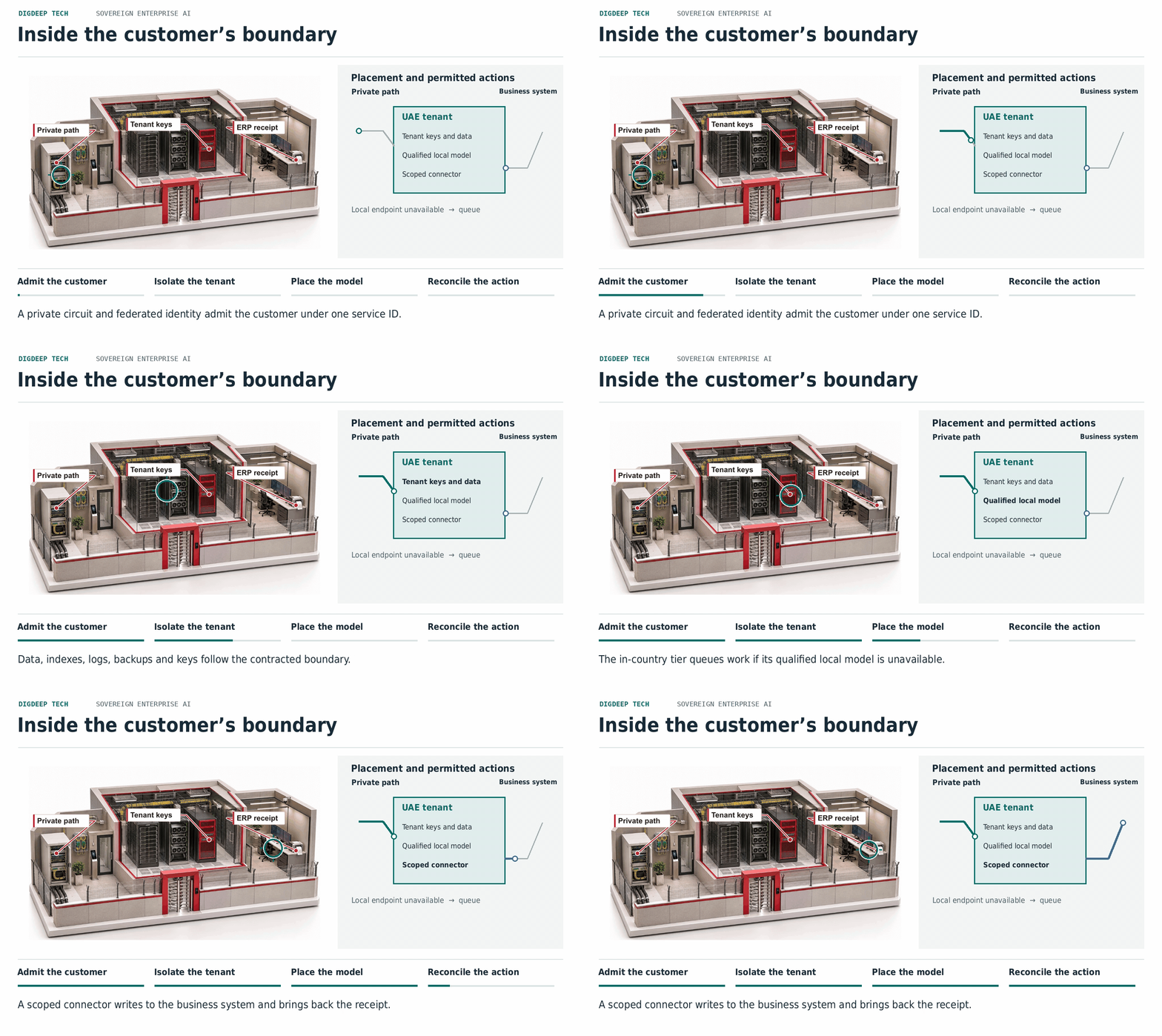
An enterprise tenant begins outside the data centre. The private circuit identifies the site, while federated identity establishes who can act and for which purpose. Inside the UAE tenant, ingestion and indexing must preserve source document permissions. Otherwise a search result can disclose an excerpt to someone who could never open the original. Tenant keys, retention, audit trails, backup placement and support access belong in the same contract as the model endpoint.
Beyond the model sits the customer’s system of record. A connector receives the least privilege required for a named action after policy checks and approval. The service reads the ERP, CRM or case transaction back to resolve an uncertain write. An energy operator, a port operator and a public-safety body could each provide a credible first process, but each would need a paid commitment and its own acceptance criteria. Reuse the tenant blueprint across buyers while keeping each buyer’s identity, data, keys and service capacity independent.

Abu Dhabi’s government digital strategy identifies sovereign cloud adoption as an objective for government operations. That makes boundaries and recovery relevant procurement questions. It does not guarantee demand for any individual supplier. Before dedicating capacity, I would contract one buyer, one process and an acceptance test that ends in the buyer’s system. The next sale should reuse the tenant design with a different customer’s keys, data and controls. Abu Dhabi Department of Government Enablement
9. Consumer agents for the bill, the home and the call
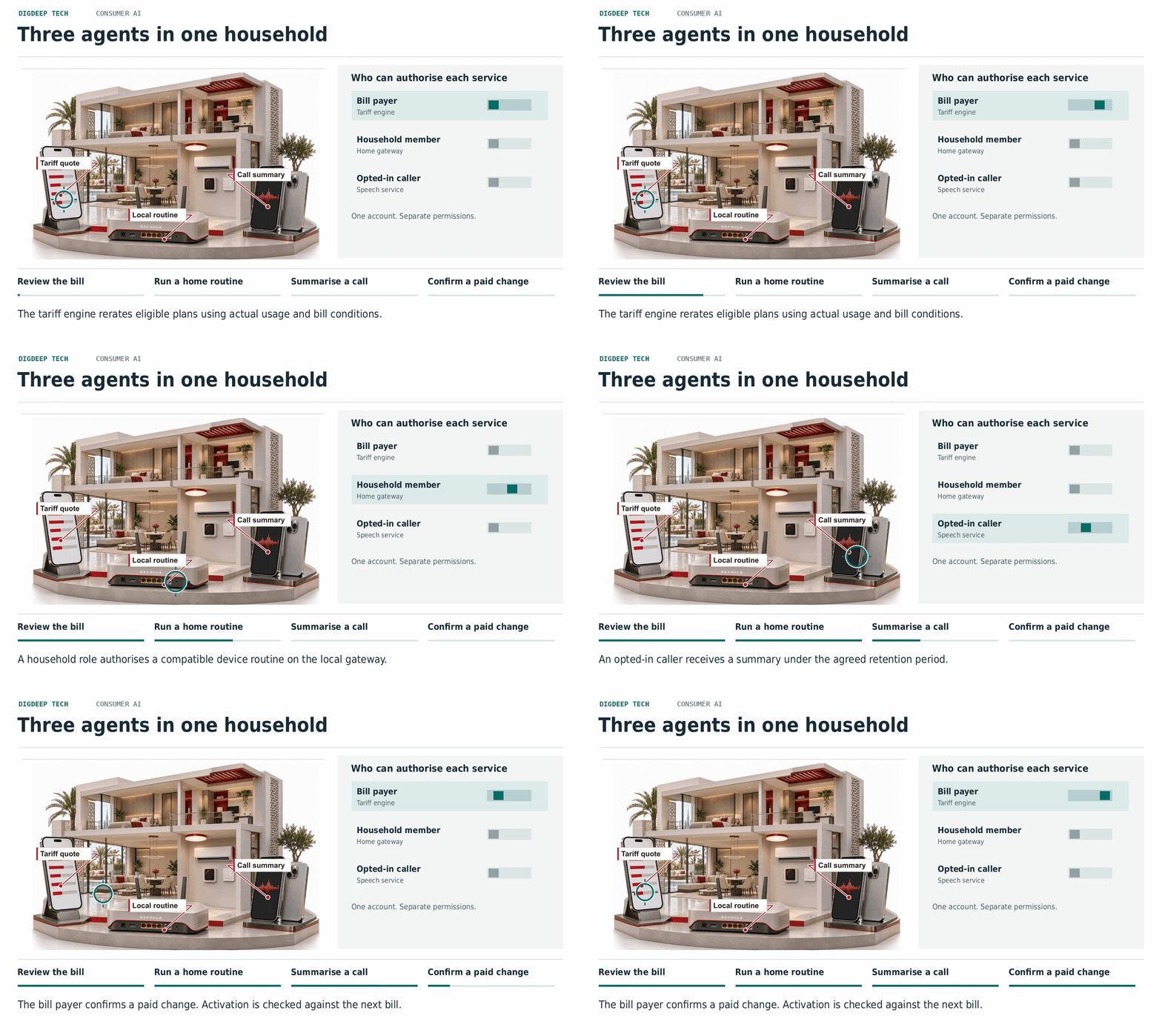
Open the operator’s app and ask a simple question. Would another eligible plan have cost less on my last three bills? The tariff engine can rerate the usage, accounting for roaming, device instalments and expiring discounts. The model can explain the quote in the subscriber’s language. The bill payer confirms a paid change, and the operator checks activation against the next bill.
The account layer must distinguish the line owner, bill payer and household member before it picks an execution engine. For bill review, the app reads permitted usage and the tariff engine rerates it against each eligible plan. The subscriber can inspect the quoted change. For the home, the broadband gateway checks the household role and can run an approved Matter routine locally. For calling assistance, the speech endpoint needs separate opt-in and an explicit retention policy for transcripts and summaries. A single consent screen can show the three permissions individually.
Fulfilment matters as much as conversation. A paid plan change or premium add-on needs confirmation, a product order, activation and reconciliation against the next bill. A voice summary has a different acceptance test: it should reach only the authorised account and expire according to the selected policy. There is a distribution precedent. A Korean operator reported more than nine million subscribers to its AI assistant by March 2025. That demonstrates reach through an operator channel. A UAE business case still needs its own paid attachment, sustained usage and contribution after support and inference. Operator annual report, p. 116

I would launch bill review first because the customer can check the result. The awkward commercial choice is whether the assistant will recommend a cheaper eligible plan. If the objective is retention, evaluate realised savings and customer retention over time. For premium home and calling features, measure paid adoption, ongoing use, support cost and contribution. A preinstalled app solves distribution. It cannot establish that the service deserves a recurring fee.
10. Group architecture from silicon to applications
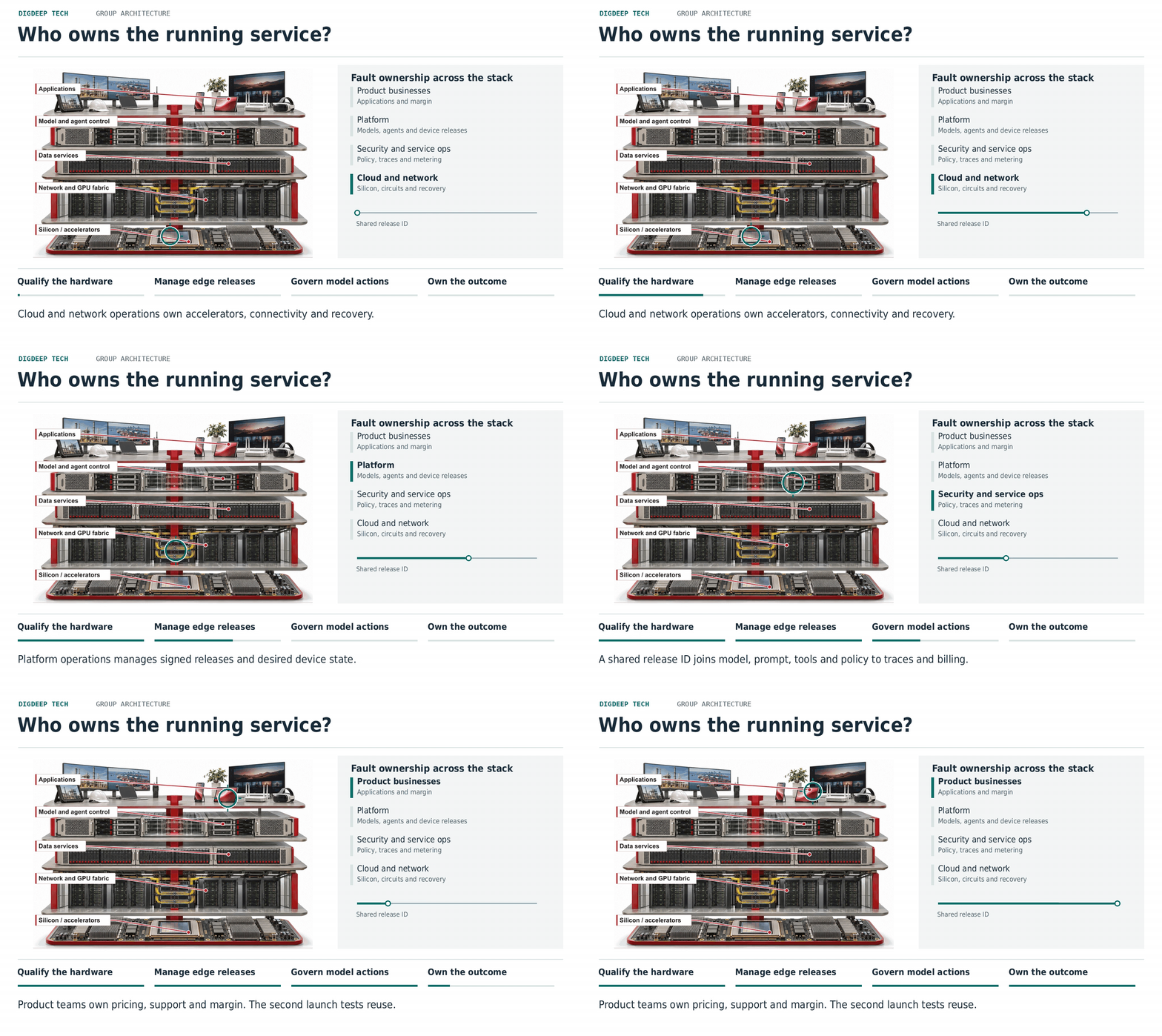
A catalogue tells a buyer what it can order. The group architecture answers a different question. Who owns the fault when a device is online, the model is healthy and the customer’s workflow still fails? Decide that before several business units buy their own versions of the same platform.
At the foundation, cloud and network operations qualify edge neural processors, accelerator pods, circuits and recovery paths. A partner compute pool can be admitted under the same location and assurance rules. The network-to-edge controller maps every node to its site and tenant, signs the deployment and reconciles the running version. Above it, model and agent control chooses a qualified local model or a non-exclusive external endpoint whose terms permit the data. A product team can switch models only if the replacement meets the service’s quality and placement requirements.
The data-services layer supplies tenant keys, inventory, policy and traces. Operations support systems use them to locate faults. Business support systems use the same identifiers to meter reservations, model calls and verified actions. The release contract pins model, prompt, tool schema and policy, then carries the same release ID into assurance and billing. At the application layer, the consumer or enterprise unit still owns price, support and margin. The board can judge the shared platform by the time and cost of its second launch, service availability and cost per verified action.

I would fund compute admission, network-to-edge deployment and agent orchestration once. Product teams should be free to select a qualified model that suits their customer. A shared release identifier makes the resulting configuration visible to operations and billing. The strongest measure of this investment is the second launch. If another business can put a supported service on sale faster, using the same permissions, telemetry and release process, the platform has earned its budget. If it still takes a fresh integration project, the group should investigate why.
11. International AI services through carrier partners
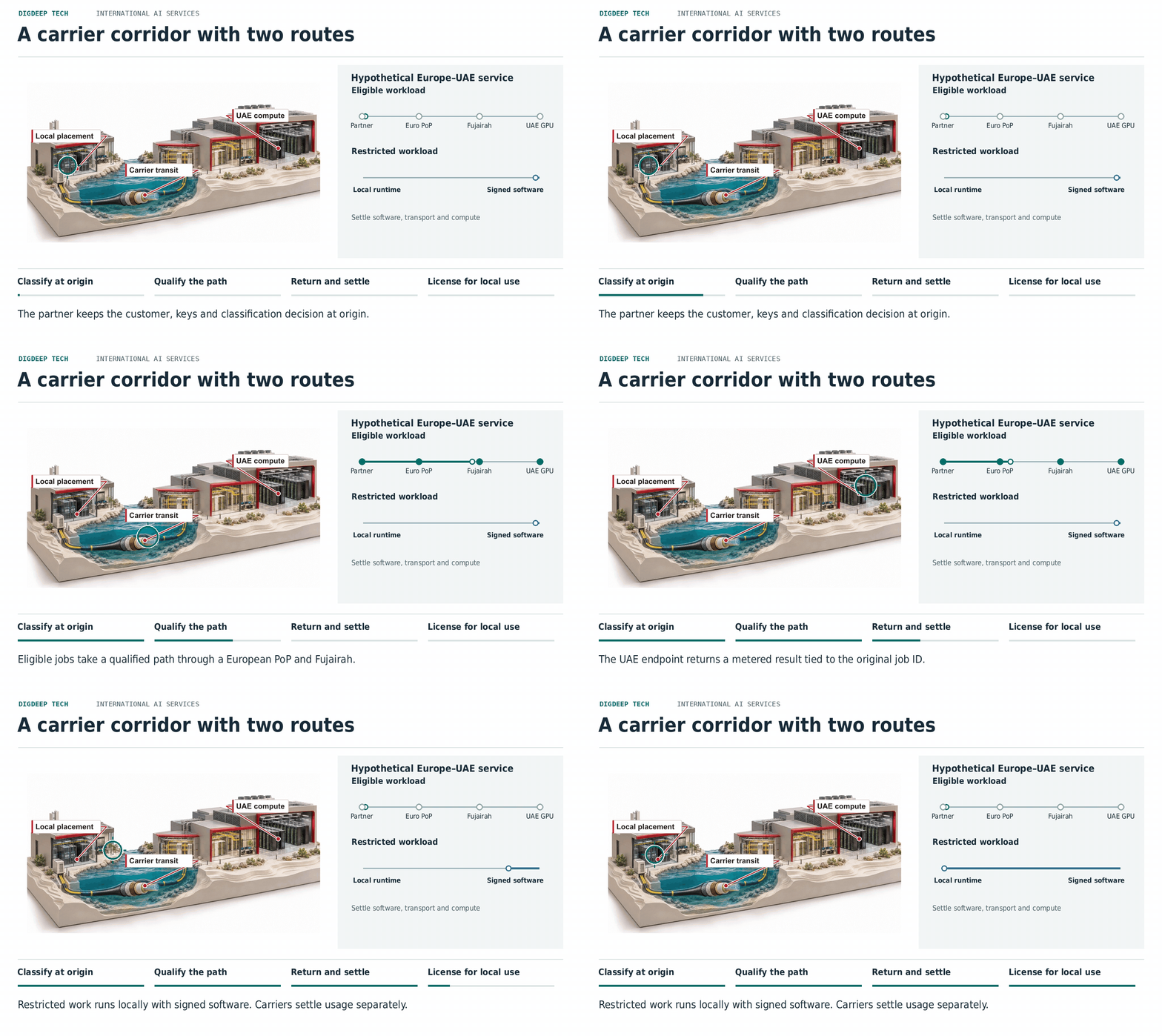
A carrier can sell access to a UAE compute pool or license a signed model, workflow and policy package for execution abroad. The contract, data boundary and revenue split look different on each route.
One plausible first corridor would connect a partner in Serbia to a European point of presence, then to a Fujairah interconnect and a UAE compute pool. The commercial parties would need to qualify two physically diverse paths, their measured latency and recovery, and the data-transfer terms for each job class. The local carrier retains the end customer, keys and support relationship. Eligible jobs travel with a reservation and deadline. The result returns with its original job ID, model digest and metering record. This is a proposed route, subject to qualification.
For restricted data and short-latency workloads, the export is software. A signed model, workflow and policy package runs at the partner edge while the underlying data stays at origin. The partners settle the software licence, reserved bandwidth and delivered GPU work separately. Even a hypothetical carrier planning more than 500 Tbps of aggregate international capacity by 2030 would still have to prove capacity and failover on this particular route. Hungary, Bulgaria or Slovakia are plausible follow-on markets once a Serbian partner has paid for a workload and both sides can demonstrate a margin on the delivered service.

Start with one partner, one paid workload and measured route performance. Include transit, support, recovery capacity and idle reservations in the comparison with local hosting. A viable software licence is a worthwhile outcome even if the customer never sends a frame abroad. Expanding to a second market should follow evidence that the first corridor works for both carriers.
For the board, I would bring back three decisions. Fund a national safety pilot against an operational acceptance test. Sell a managed vision deployment that can pay for its site support and model updates. Use both to test which platform components genuinely carry over. GPU ownership, shared fleet inference and international expansion would each have to clear their own commercial hurdle. That keeps investment close to the promises customers are willing to buy.

Join the conversation