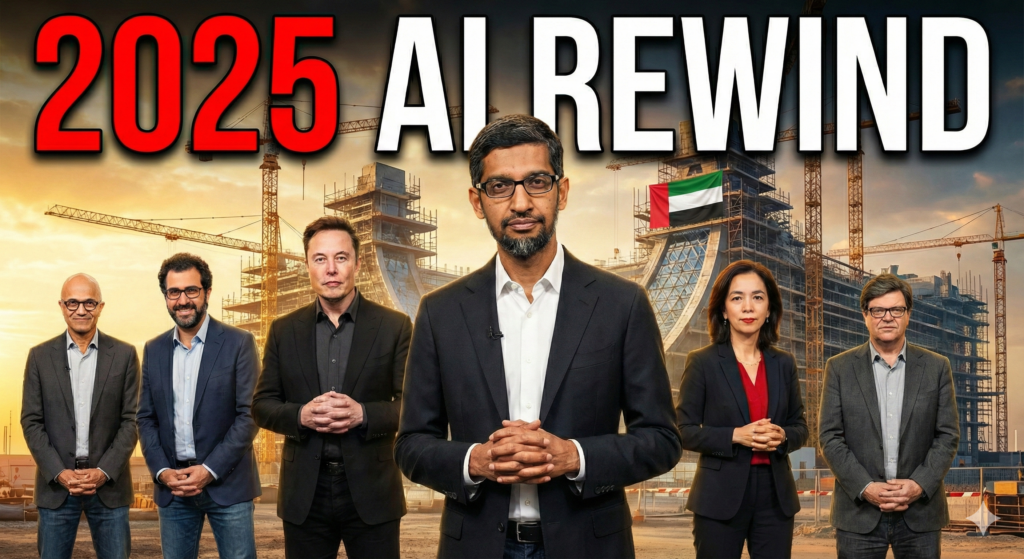
If you are still waiting for the AI dust to settle you have already lost!
2025 wasn’t just another year of tech demos. It was the year the physics of intelligence changed. We moved from the “Magic” phase of 2023 and the “Pilot Purgatory” of 2024 into the Year of the Engine.
I have spent some time analyzing the data and the conclusion is brutal. The romantic era of AI is dead. We are now in a ruthless economic phase defined by thermal dynamics, sovereign capability, and the unforgiving laws of unit economics.
The market has bifurcated. On one side you have thousands of “wrapper” startups suffocating under the “NVIDIA tax” and unable to find margin. On the other you have a new class of Vertical Hegemons and Sovereign Clouds rewriting the rules of ownership.
This is no longer about who has the best model. It is about who has the power. Literally. As the “Energy Wall” caps compute growth in the West the locus of power is shifting to the Gulf. The UAE’s Stargate project isn’t just a datacenter. It is a geopolitical statement that energy sovereignty is the only true moat left.
Here is a deep dive on the five key trends that defined AI in 2025.
1. Vertical Hegemony: The Death of the Middleman
For the last two years the narrative was simple. OpenAI had the magic and everyone else was catching up. But if you look at the infrastructure level that story has flipped. 2025 revealed the fatal flaw of the API-wrapper business model. Dependency.
While the market fought over H100 allocations Google executed a silent coup. By vertically integrating their new TPU v7 Ironwood silicon with the Gemini 3 model stack they have effectively bypassed the margin-crushing costs that plague every other competitor.
The Ironwood Advantage Google’s new TPU v7 “Ironwood” isn’t just a chip. It is a system. It connects 9,216 chips into a single superpod using optical circuit switching (OCS) which allows them to reconfigure the network topology in milliseconds if a node fails. They share a massive 1.77 petabytes of high-bandwidth memory across the pod.
Why does this matter? Because it gives Google a 4x performance-per-dollar advantage over standard NVIDIA H100 clusters for inference workloads. While competitors are paying a premium to third-party vendors Google is serving intelligence at cost.
The “Android 16” Moat: This cost advantage allows Google to do something OpenAI cannot. They have deployed native 2-million-token agents directly onto Android 16. These agents don’t just chat. They have “System Latency” advantages because the “Nano” version of Gemini 3 triages requests locally on the device’s NPU before offloading to the cloud. This hybrid architecture slashes the Total Cost of Ownership (TCO) per query by up to 50%.
My Take: Stop looking at the leaderboard of “smartest chatbots.” Look at the unit economics of inference. The winner of 2026 is the one who can serve Sovereign Inference at global scale without hitting the margins wall. If you are a startup paying retail prices for intelligence you are already dead.
2. The Reasoning Economy: Why “Vibes” Are Over
We need to stop talking about “knowledge retrieval.” The era of AI as a glorified search engine is over. The defining shift of 2025 was the move to Test-Time Compute. We are now allowing models to “think” before they speak.
This shift is quantified by a new metric that matters more than any academic test. The GDPVal benchmark.
The 70.9% Threshold Unlike the MMLU which tests multiple choice questions GDPVal measures performance on economically valuable deliverables across 44 distinct occupations and 9 major sectors of the US economy. The latest data shows that GPT-5.2 now matches or beats human experts with 14 years of experience 70.9% of the time on professional-grade tasks.
This is not about writing poems. This is about drafting legal briefs, debugging microservices, and analyzing radiographs. We have crossed the threshold where AI is 100x faster and 100x cheaper than human labor for high-value cognitive workflows.
Commercial Proof: The $1B Run Rate The theoretical power of reasoning found its killer app in Claude Code. In November 2025 Anthropic reported that Claude Code hit a $1 billion revenue run rate just six months after its full public launch.
That is faster than Slack. Faster than Zoom.
Why? Because it doesn’t just “suggest” code. It fixes it. It acts as an agent with shell access. To cement this lead Anthropic actually acquired Bun (the high-performance JavaScript runtime) to optimize the infrastructure their agents run on. They are building a closed loop where the AI writes code optimized for the AI’s preferred environment.
My Take: Intelligence is no longer a static asset you buy. It is a dynamic resource you burn. Leading firms are now allocating massive compute during the query phase to simulate logic paths. This drops hallucination rates by 90% in mission-critical tiers. If you aren’t budgeting for “inference burn” you aren’t actually using AI.
3. Sovereign Energy: The “10,000x” Growth Cap
This is the most critical pillar for anyone looking at the geopolitical map of AI. The constraint on growth is no longer silicon supply. It is electron supply.
The Physics of the Bottleneck: Data from Epoch AI highlights a terrifying “Energy Wall.” While chip manufacturing could support an 80,000x increase in compute by 2030 our power grids effectively cap that growth at 10,000x.
We are hitting a hard physics limit. In major Western hubs like Northern Virginia wait times for grid connections are stretching to 4+ years. The grid simply cannot keep up. This has forced Big Tech into a “Nuclear Pivot” with Google and Microsoft rushing to commission Small Modular Reactors (SMRs) from Kairos Power just to keep the lights on.
The GCC Lead: Stargate UAE But while the West struggles with regulation and aging grids the Gulf Cooperation Council (GCC) has seized the advantage.
Look at Stargate UAE. It is a 5-Gigawatt “Compute Refinery” in Abu Dhabi. By integrating the Barakah Nuclear Plant directly with the world’s largest cluster of NVIDIA Blackwell chips the UAE has created a structural cost advantage.
Partners like G42, OpenAI, Oracle, and SoftBank are building a new jurisdiction for compute. The e& enterprise “Sovereign Inference” platform allows companies to run workloads that never leave UAE borders ensuring total data sovereignty.
My Take: Energy is the new moat. Stargate offers a cost of inference that is structurally lower than the strained US grid. The UAE is effectively treating compute tokens like oil barrels. They are a refined energy product exported to the world. For a global AI leader the question is not “which cloud?” It is “which grid?”
4. Agentic R&D: The Race Against Depreciation
We have to be honest about the labor market. The “AI will only augment humans” narrative is being dismantled by the hiring data.
The Labor Shift Job postings for AI-exposed engineering roles have dropped by a massive 42% according to the Kenn So 2025 AI Trends report. This is the “Billion-Dollar ROI” of Agentic R&D. Companies are maintaining output while shedding headcount because tools like Claude Code allow one senior engineer to do the work of five.
The Financial Fragility But there is a hidden financial risk here that few are talking about. Asset Depreciation.
In the 90s telecom boom companies laid fiber optic cables that are still useful 30 years later. In the AI boom we are spending billions on GPUs that have a useful life of maybe 3 to 4 years. If you buy an H100 today it is effectively e-waste by 2029.
My Take: You cannot sit on these chips. You are in a race against depreciation. This forces a “use it or lose it” dynamic. The only way to justify this Capex spend is to deploy Agentic R&D. You must use AI to radically compress timelines in drug discovery and material science. If a cluster can discover a billion-dollar drug in six months the depreciation does not matter. If you are using it to write marketing emails you are going bankrupt.
5. Spatial Intelligence: Real World Models
Finally we are seeing the end of the “Text Era.” Leaders like Fei-Fei Li have been vindicated. LLMs are a dead end for understanding reality. To build robots that can actually work AI needs Spatial Intelligence.
From Words to Worlds 2026 is the year of World Models. These are systems that understand physics, 3D causality, and geometry.
Fei-Fei Li’s World Labs has launched Marble a generative model that creates editable interactive 3D worlds. This allows robots to train in a simulation that obeys the laws of physics rather than the slow dangerous real world.
The Physical Bridge We are seeing this bridge to physical labor with Tesla’s Optimus Gen 3 which is running pilots in BMW factories today. These robots are building a “mental map” of the factory floor and simulating millions of scenarios before they move a muscle.
My Take: The digital world is finite. The physical world is infinite. The ultimate prize is not a chatbot. It is an Embodied Agent that can labor in the physical economy. The GCC with projects like NEOM is positioning itself as the primary deployment zone for this technology. They are building cities designed for robots from the ground up.
Conclusion: The New Rules of the Road
The data from 2025 makes one thing clear. The experiment is over.
- Vertical Integration is Survival. If you do not own the stack (like Google) or the energy (like the UAE) you are just a margin-compressed middleman.
- Reasoning is the Product. The market will pay for work not words. The $1B run rate of Claude Code proves it.
- Energy is Destiny. The “Energy Wall” is real. The future of AI leadership belongs to those who control the electrons.
I am betting on the regions and companies that understand this new physics. The Intelligence Economy is here. It is powered by nuclear energy, sovereign silicon, and agentic reasoning.
Sources
Goldman Sachs. (2025). AI in a Bubble Report.
Google Cloud. (2025). TPU v7 Ironwood Architecture & Performance.
NevSemi. (2025). Google TPU Ironwood Technology Explained.
AI News Hub. (2025). AI Inference Costs: TPU vs GPU 2025.
Kashif Mukhtar. (2025). Google Gemini 3: A Professional Review.
OpenAI. (2025). GDPVal Benchmark Results: GPT-5.2.
Vertu. (2025). GPT-5.2 Hype vs Reality.
The Information. (Nov 2025). Claude Code Nears $1 Billion in Revenue.
Summit Ventures. (2025). Anthropic Company Overview.
Anthropic. (Dec 2025). Anthropic Acquires Bun.
Harvey AI. (2025). BigLaw Bench Hallucinations Report.
Epoch AI. (2025). Can AI Scaling Continue Through 2030?
Singularity Hub. (2025). AI Models Scaled Up 10,000x are Possible.
World Nuclear News. (2025). Google, Kairos Power, TVA announce collaboration.
Blackridge Research. (2025). Facts You Need to Know About OpenAI Stargate.
Khazna Data Centers. (2025). Stargate UAE Progress Update.
e& enterprise. (2025). Sovereign Inference AI Platform.
Kenn So. (2025). AI Trends 2025 Report.
Sundeep Teki. (2025). Impact of AI on the 2025 Software Engineering Job Market.