
Last week, I wrote A ChatGPT-Powered Robot? Not So “Fast”!. I was bullish on general AI in robotics, but quite selective about where I would let it take control.
Then I saw Jiaming Tang’s post about PEAR. An open reasoning model, trained in simulation, controlling a real robot. Code, paper and weights all available.
The result that got me was much less flashy than the demo: what happens when you give the robot a different instruction?
Same room. Different request.
On the standard LIBERO tasks, the reported π0.5 result is 96.9%. PEAR’s LIBERO-only model gets 74.4%. A fairly comfortable win for the specialist.
Then the instruction changes. The scene stays familiar, but the robot is asked to do something else.
PEAR gets 57.4%. π0.5 gets 0.75%.
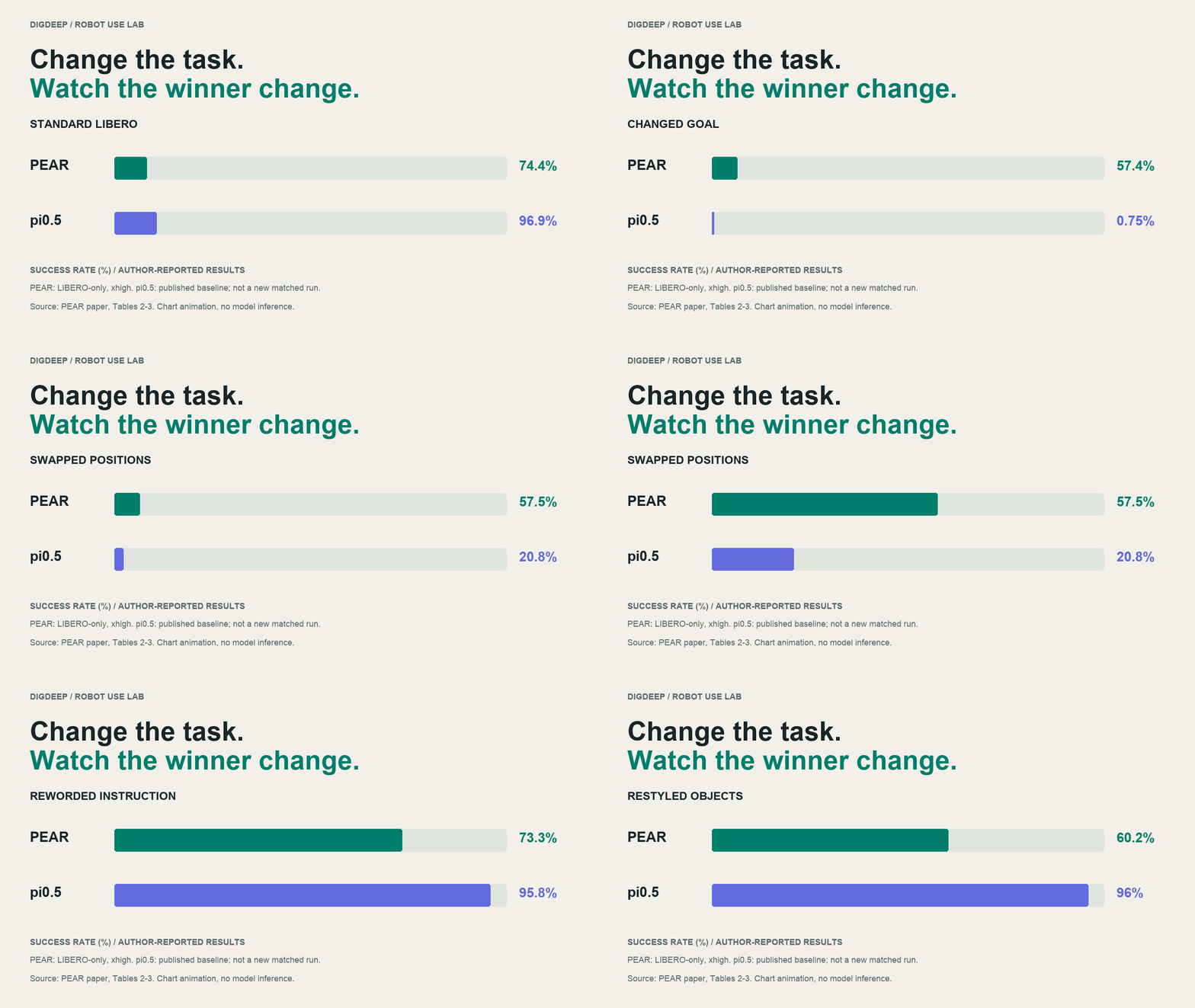
That is a huge gap. It is also a very specific test. The π0.5 numbers come from prior evaluations, so this doesn’t isolate architecture from training choices. I would love to see a comparison with matched task coverage and training budgets.
Still, this is exactly the question I want answered before calling a robot general purpose. If I change my request, does it follow me, or repeat what usually happens in that room?
A factory repeating one operation might care most about the first score. A robot taking requests around a home may have a different problem.
Robot use as another model capability
PEAR starts with Qwen3.8-27B. It looks at camera images and the arm’s state, reasons about what to do, then writes an action as text. An inverse-kinematics solver and a controller turn that into movement. The model observes the result and tries again.
The training is reinforcement learning in simulation: reward it when the task succeeds. No demonstrations during this RL stage. That doesn’t mean the base model’s entire pretraining history contains no robotics data.
What I like is how familiar this looks. A model using a browser sees a screen and chooses a click. Here, it sees a scene and chooses the arm’s next pose.
The authors also report no measurable loss across nine general reasoning, coding and vision benchmarks after training. It learns to use a robot while retaining those broader abilities.
Their painting and chemistry demonstrations make that idea easier to see. They require detailed prompts, and the videos remove pauses or speed up parts of execution, so watch the original annotations. But connecting general knowledge to a physical action is a pretty compelling direction.
Watch the PEAR team’s original demonstrations
In my earlier article, I used System 2 for deliberation and System 1 for faster action. I still find that useful. I am less convinced those jobs will always belong to completely separate model families.
So, thank you VLAs and WAMs?
Yes. Although I wouldn’t throw either away just yet.
Vision-language-action models already build on broad pretraining. World action models bring a different strength: learning how the world changes as actions happen. The boundaries overlap.
My bet is that more of the robot’s task understanding, adaptation and recovery will move into broadly capable models. They may use a fast specialist for movement, consult a world model, or acquire more of those abilities through training.
There is a practical reason I find that attractive. Better vision, better memory, better reasoning and better tool use are being developed for an enormous range of applications. Robotics gets to build on that progress.
If I were building a robotics company, I would want a good answer to this: when the next general model improves, how much better does our robot get?
I built a small lab around the numbers
I put together Robot Use Lab to explore the results, with the code and evaluation recipe on GitHub.
So far, this is an analysis of the published data. I haven’t run the 27B model or reproduced the robot trials.
You can change the mix of standard and changed-goal tasks and watch which policy the reported numbers favour. It is a simple weighted calculation, useful for showing how much a supposed winner depends on the workload you have in mind.
I also unpacked the real-robot result: 18 successes out of 30 trials for the final model. Twelve failures.
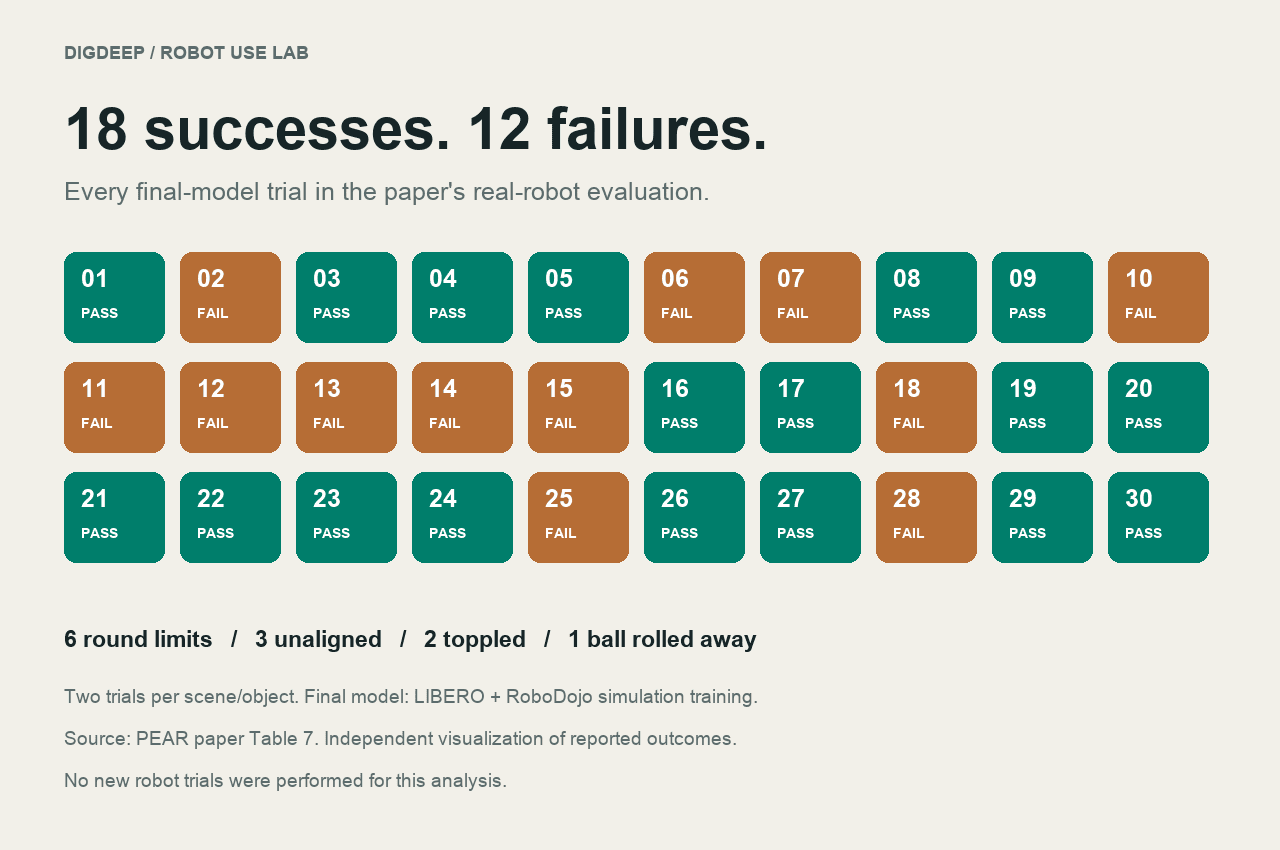
The corresponding task types had been practised in RoboDojo simulation. The transfer to a new physical robot is impressive. It doesn’t establish that the model can handle any unfamiliar household job.
The wider RoboDojo evaluation is much tougher: 5.5% under the paper’s dimension-averaged scoring. Context exhaustion is a major problem. There are also complex RoboLab tasks where Cosmos3-Nano-Policy does better.
And there is the very physical problem of time. A robot can understand the request and still spend far too long deciding on its next move. The paper’s accuracy tests and fastest quantized inference results use different configurations; I wouldn’t combine them into a claim about real-time performance.
For the next experiment, I’ve prepared an 80-episode evaluation across original goals, changed goals, swapped positions and other perturbations. That still needs a compatible NVIDIA environment. The recipe is ready; the results aren’t.
Where I land
PEAR makes me more bullish on general-purpose models in robotics. It also gives me a much better set of things to test.
I want to see new instructions, recovery after a bad grasp, longer tasks, and the time spent deciding what to do. Those are the details that turn an impressive demo into something I would trust to work around people.
My last post on SuperMimic looked at learning a model of motion. This one pushes the other side of the question: how much physical capability can we teach a model that already understands a lot about the world?
I think the generalists have a very good shot.
Credit to Jiaming Tang, Zhuoyang Zhang, Junxian Guo and the full PEAR team for making the work available to inspect. The release is what makes experiments like this possible.
The four sources behind this post: project and demos · paper · code · model weights.
Try Robot Use Lab · My projects and writing at DigDeepTech
Jiaming Tang’s original PEAR release post
I also find Analog’s approach to physical intelligence compelling: give robots shared context through a living world model, then connect that understanding to action. Better general-purpose reasoning can make that foundation more useful. I see these as complementary parts of the system I would want to build.
Follow the series on DigDeep Tech on Substack, LinkedIn, and X. Explore the source data and runnable experiments in Robot Use Lab on GitHub.
Join the conversation on Substack, LinkedIn or X.
Related reading
Continue with general-purpose AI and robot control, SuperMimic, world models and physics simulators, and what it takes to deploy robotics.
For the regional perspective, explore my AI and robotics writing for the UAE and advisory, workshops and speaking for UAE and GCC teams.


Join the conversation